
Tapping Water Rights for California Agriculture
Agriculture in California uses a lot of water and also helps produces a lot of value. For 2025, California farmers earned $65 billion in cash receipts (California Dept. of Food and Agriculture, 2025):
California’s agricultural abundance includes more than 400 commodities. Nearly half of the country’s vegetables and over three-quarters of the country’s fruits and nuts are grown in California. California’s top 10 valued commodities for the 2025 crop year are [listed by sales, dairy at top: Dairy Products/Milk, Almonds, Cattle/Calves, Grapes, Lettuce, Pistachios, Strawberries, Carrots, Broilers, Tomatoes]
The Sun shines energy to Earth and California enjoys 273 sunny or clear days a year according to NOAA. Not as many as Arizona, Nevada, and New Mexico, but more than average for other US states. That sunshine can power solar panels or with carbon dioxide and water can grow plants, plankton, and microbes.
Water is essential, along with sun and CO2, for flourishing agriculture. But water has other uses as well. How much of California’s water should flow to agriculture? Half of available water is directed to environmental uses according to Just the Facts paper “Water Use in California” (July 2014):
Statewide, average water use is roughly 50% environmental, 40% agricultural, and 10% urban. However, the percentage of water use by sector varies dramatically across regions and between wet and dry years.
California rivers provide habitat for fish as well as for fishing and recreation, as they deliver water to California farms, communities, cities, and to oysters along the seashore.
The Salinas Basin Water Alliance was formed in 2020 to:…

… in an effort for growers to track and engage with public water policy regarding groundwater supply. As state requirements for basin management increase, the Alliance is working to protect sustainable water rights and equitable water supply throughout the Salinas Valley for the long term.
Water for farming falls from the sky, or is pumped up from the ground, or desalinated from California’s coastal waters. Or water could be piped and pumped across Oregon from the Columbia River... (Also William Shatner’s Kickstarter campaign from 2015.)
California and other southwestern states have long struggled with both dry spells and flooding. Doughts and flooding are two sides of the same coin. Mother Nature gives us rain but sometimes too much or too little.
Across California are some 1,500 reservoirs to store rainwater in rainy times for dry times (Dams in California Fact Sheet, 2019). Is that enough reservoirs? Or too many? Who should decide? And is extra water best stored in above ground reservoirs, or maybe better stored in the soil and groundwater?
California has a plan for El Niño’s torrential rain: Save it for later in Grist (a publication reporting on “climate change, environmental justice, and sustainable solutions”) reports on state water management plans. Damage follows when more groundwater is pumped out than is replentished:
…The issue is particularly acute in the agricultural Central Valley, where farmers have drawn so much groundwater that aquifers have been collapsing like empty plastic bottles, causing the land to sink by nearly 30 feet.
But that problem is also an opportunity. Whereas the state’s major reservoirs currently hold around 21 million acre-feet of water — that is, the amount it’d take to cover an acre in a foot of the stuff — its land could hold something like a billion acre-feet underground, according to Michael Kiparsky, director of the Wheeler Water Institute at the University of California, Berkeley. “So the potential room for storage is immense,” Kiparsky said. “The enticing question is: Is there a way to grab those flood flows before they flow out to sea, and hold them underground, and therefore expand our capacity?”
A previous post (Adventures in Terraforming: Going Green with Turtles, Beavers, Buffalo, Elk, and Cattle, September 7, 2026) shares stories of animals that store water and restore ecosystems by making dams (beavers), wallows (buffalo), and of turtles and ruminants that break up and fertilize hard ground, opening it to better soak in rainwater to feed plants and underground microbes.
More beavers could store a lot of California water:
Beavers build dams and create wetland ecosystems that store water, keeping vegetation green and healthy. Further studies have found that these wet, well-connected habitats create pockets of fire-resistant landscape that do not burn, even in some of the most severe wildfires, providing robust refuges for beavers, birds, fish, frogs, bears, deer, and even humans during and after a fire. …Using a model called the Beaver Restoration Assessment Tool (BRAT)(link is external)…They found that beavers in the Sierra Nevada have the potential to make approximately 2,200 square kilometers worth of fire refuge—roughly the size of 24,000 football fields—and to store nearly 120 million cubic meters of water, which could fill 48,000 Olympic swimming pools.
California’s busy as beavers farmers can also store more water on their own land, given the right incentives (and post-1914, permits). One incentive to generate incentive is property rights. In California “water is a public resource belonging to all state residents and much of California has “use it or lose it” water rights systems. So farmers grow water-intensive rice, alfalfa, and almonds, and other crops in dry areas. Whether these crops are profitable turns in large part on the price farmers pay for the water they use.
The article Yes on Prop 45: A more affordable California starts with reliable water (The Sun, October 21, 2026) explains:
Water is at the core of almost every challenge that farmers face across California. In wet years, billions of gallons of water flow through our rivers and out to sea while farmers and communities struggle to prepare for the next drought. We know we need more reservoirs, groundwater recharge facilities and other infrastructure to capture and store water when it’s available. Yet California’s outdated permitting system makes building that infrastructure unnecessarily slow, expensive and difficult.
That is why the San Joaquin County Farm Bureau supports Proposition 45, the Building an Affordable California Act. We represent over 1,400 family farms and ranches across San Joaquin County, all of which depend on reliable water supplies. Proposition 45 would help deliver that supply by building essential water projects faster and more affordably.
Proposition 45 would establish clear, enforceable timelines for the environmental review and permitting of essential projects, including water storage, groundwater recharge and water delivery infrastructure. It would require agencies to complete environmental impact reports within 365 business days, while establishing deadlines for the additional permits and approvals needed to begin construction.
Water markets would allow farmers to discover alternative uses for their land and their water, and to better evaluate water storage options.
When farmers decide to invest in water retention by flooding their land, building reservoirs, or breaking up topsoil to allow more rainwater to soak into the soil, are they allowed to later recover that water during dry times? Or is the water they store “a public resource belonging to all state residents”?
Cattle, horses and other ruminant also open the soil to help absorb water and reduce flooding. Google AI response:
Cattle can significantly improve topsoil water absorption through a process known as managed intensive grazing or holistic management. When managed correctly, their physical impact on the land acts as a natural cultivation tool.
Here is how cattle help permeate topsoil and enhance water infiltration:
- Hoof Action as Micro-Tillage
- Breaking the Crust: In arid or brittle environments, the soil surface often forms a hard, hydrophobic crust or capping. Cattle hooves break this crust, opening up the soil surface.
- Creating Micro-Basins: Each hoof print creates a tiny depression that acts as a miniature pocket to capture rainwater, reducing immediate surface runoff and giving water time to sink in.
Tapping Water Markets in California (PERC, 2016) written during drought years, reviews ways market forces (prices, supply and demand, entrepreneurship) can address water scarcity challenges:
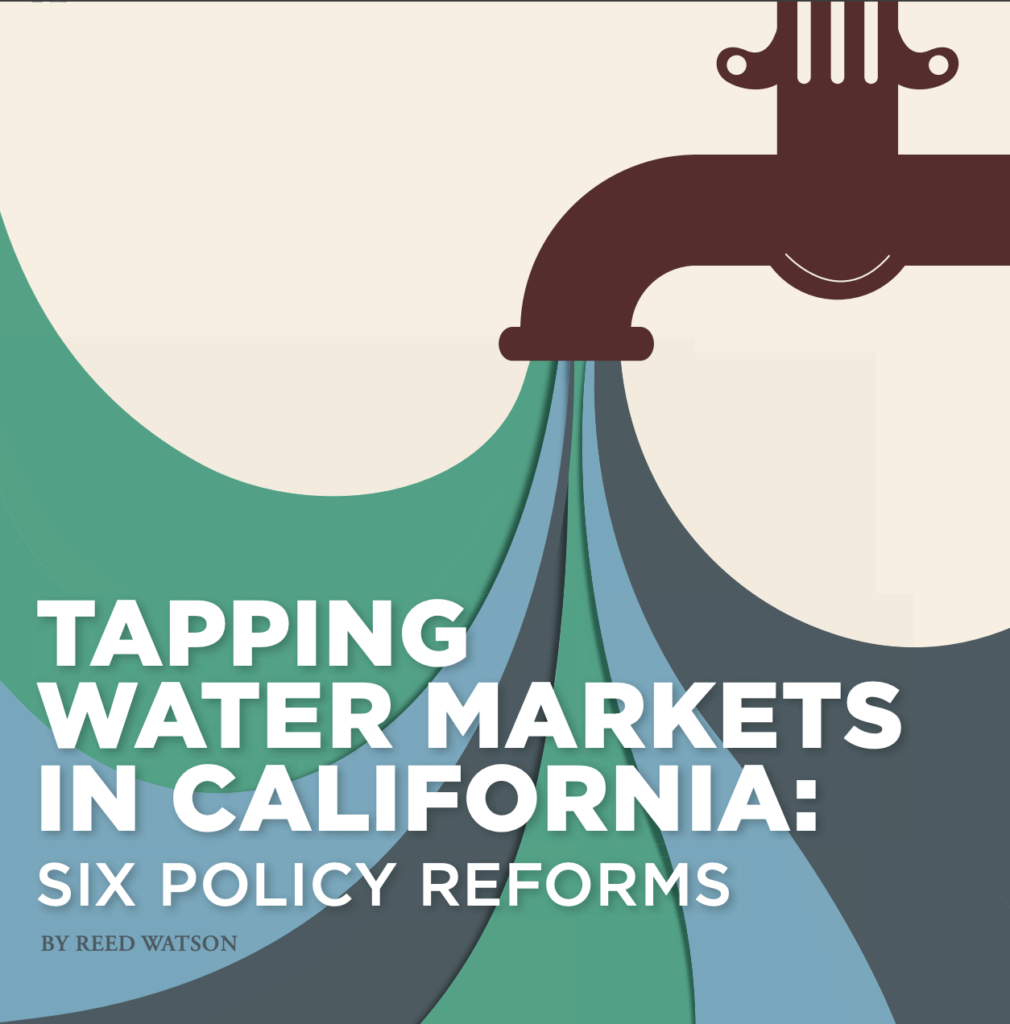
This report offers an answer: water markets. Markets allow competing water users to cooperate rather than fight over scarce water resources. By encouraging water conservation and facilitating trades, California can alleviate the economic and environmental effects of water scarcity, in both the short term and the long term.
The policy reforms advanced in this report are relatively subtle, and that is by design. Previous efforts to overhaul California’s water allocation system have failed, in part, because they would have disrupted settled expectations and favored certain uses only at the expense of others. Fortunately, even minor modifications would go a long way toward fostering mutually beneficial water trades. The critical challenge is to encourage water marketing in ways that do not jeopardize the rights of other water users or the quality of California’s environment.
Among recommendations in the report:
…that California streamline transfer approvals, modify the water code to explicitly recognize underground aquifer storage as a beneficial use, and decentralize water dispute resolution.
Though annual USDA farm subsidies are forecast at $44 billion in 2026 ($20 billion more than 2025), California farmers receive about 4.2% of that according to the Environmental Working Group. Low-cost water from the Colorado River isn’t included in as a USDA farm subsidy.
More on California water policies and allocations: Water for What: California Oysters or Chinese Beef? (September 7, 2013). Why pour so much water on late summer alfafa headed to China:
In 2012, the drought-stricken Western United States will ship more than 50 billion gallons of water to China. This water will leave the country embedded in alfalfa–most of it grown in California–and is destined to feed Chinese cows. The strange situation illustrates what is wrong about how we think, or rather don’t think, about water policy in the U.S. (Source WSJ, quoted here.)
And California can cut Colorado River use by pumping more water from the ocean. An alternative to desalinization to save farming and restore recreation around the Salton Sea. See: Pumped Hydro to Replenish the Salton Sea and Bring Death Valley to Life (August 23, 2013)