
Swiss Re and OwnaHealth Turn Metabolic Insight into Action
Swiss Re ran a small UK pilot program for long-term disability claimants, working with doctor and clinic:
…to deliver a novel, nutrition-first, evidence-based programme focused on improving insulin resistance through sustainable lifestyle change.
The pilot was fully integrated into claims management. Claims assessors were trained to identify metabolic risk and triage suitable cases. Eligible claimants were offered either a one-week residential or a 12-week virtual programme of one-to-one and group sessions, led by health coaches and dietitians, with clinical oversight and integrated vocational rehabilitation. Both pathways included 12 months of follow-up to support long-term behaviour change.
Results so far? Of fourteen long-term disabled in pilot, five have returned to work. Two others “are preparing to return in work.” Also: reduced medications and “reversal of pre-diabetes and diabetes in some cases” and average weight loss of 16 pounds and waist size reduction of 4 inches.”
Swiss Re spent some $43,000 to fund the pilot project and saved $1.1 million releasing claims reserves. So a 20x return on investment.
Swiss Re reflects on the implications of their UK disability pilot for health insurance companies:
Beyond the UK disability context, the implications are wide-ranging. The same metabolic mechanisms drive experience across critical illness, total permanent disability, and mortality products. For insurers, this opens opportunities across the value chain, globally…
Metabolic Health Insurance Experience in the U.S.

Medicare and Medicaid are vast health insurance operations. And they are both trouble. Of the projected $119 Trillion budget deficit for 2023-2053, Medicare is most with a $45.9 trillion program deficit (expenses over income) plus $31.1 trillion for interest.
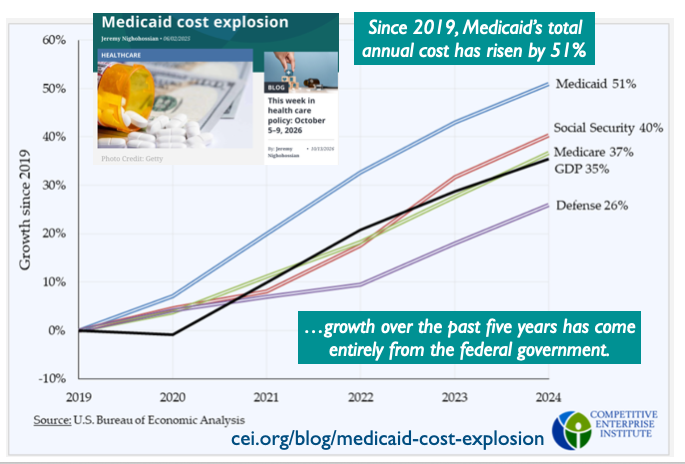
Medicaid spending has grown even faster, but is expensed annually rather than to a federal trust fund.
What insight does the Swiss Re disability pilot offer for Medicare and Medicaid? Consider the success of OwnaHealth, a New York City metabolic health firm providing services for severely ill Medicaid patients.
Nina Teicholz in her Medscape commentary, For Richer, for Poorer: Low-Carb Diets Work for All Incomes (July 17, 2024), reports on OwnaHealth’s success working with Medicaid provider Essen Health Care, initially with a: “100-person pilot program for endocrinology patients. Essen is the largest Medicaid provider in New York City.”
Teicholz reports on Ajala Efem’s OwnaHealth experience:
Efram had to wait 8 months for an appointment with an endocrinologist, but that visit proved to be life-changing. She lost 28 lb and got off 15 medications in a single month. Efem did not join a gym or count calories; she simply changed the food she ate and adopted a low-carb diet.
“I went from being sick to feeling so great,” she told her endocrinologist recently: “My feet aren’t hurting; I’m not in pain; I’m eating as much as I want, and I really enjoy my food so much.”
Here is Efem sharing her metabolic heath journey:
Insulin five times a day, following advice of her doctors… Then she found a new doctor offering Telehealth services and metabolic measurements so Efem could connect her own diet with her blood glucose levels, and adjust accordingly (with guidance from her online doctors and nutritionists).
Nina Teicholz in her Medscape article shares other OwnaHealth success stories (Jerrilyn, Samuel Gonzalez, Melissa Cruz) These are anecdotes, and Teicholz says so. They match a larger record, though. An audit of 344 patients at Glandt’s earlier clinic in Tel Aviv found that after six months on a very-low-carbohydrate diet, median A1c among patients with diabetes fell from 7.6% to 6.3%. Of the 78 patients on insulin, 62 stopped taking it.
How coaching and remote monitoring make it scale
High-touch care may sound costly. But OwnaHealth provides a virtual clinic with patients offered video visits, a dietitian, and daily chat with coaches.
GrokBot provided the following text:
Meal plans are low-carb and culturally tailored, and they’re built to be affordable on SNAP. The app tracks CGM readings, weight, ketones, blood pressure, mood, and cravings. AI-assisted workflows flag patients who need attention, so a small clinical team can follow many people every day instead of seeing them every few months. As patients improve, physicians safely reduce insulin and other drugs
The company reports encouraging early results from its own programs: average A1c falling from 9.0% to 7.3% while medications were reduced, 28% of patients below the diabetes threshold after three months, nearly 60% of insulin users off insulin after an average of six months, and a 45% drop in depression symptoms. These figures are company-reported and observational, not from randomized trials. They deserve independent confirmation, but they point in the same direction as the published evidence.
OwnaHealth has partnerships with Essen Health Care and BronxCare. In October 2026 it announced a partnership with Sun River Health, New York’s largest network of federally qualified health centers, with 50 sites serving more than 240,000 patients a year. According to Crain’s New York, the deal opens access to about 100,000 eligible patients.
The broader model has a well-funded precedent. Virta Health, which pioneered nutrition-first diabetes reversal for employers and health plans, reports more than $160 million in annualized revenue and recently announced its first profitable quarter. OwnaHealth applies the same idea to the patients who need it most and are usually served last: Medicaid and underserved communities.
Nina Teicholz concludes her 2024 Medscape commentary:
This early success in one of the United States’s poorest and sickest neighborhoods should give us hope that type 2 diabetes need not to be a progressive irreversible disease, even among the disadvantaged.
OwnaHealth’s track record, along with that of Virta and other similar low-carbohydrate medical practices also give hope to the Food-Is-Medicine idea. Diabetes can go into remission, and people can be healed, provided that health practitioners prescribe the right foods. And in truth, it’s not a diet. It’s a way of eating that must be maintained. The sustainability of low-carbohydrate diets has been a point of contention, but the Virta trial, with 38% of patients sustaining remission at 2 years, showed that it’s possible. (OwnaHealth, for its part, offers long-term maintenance plans to help patients stay very low-carb permanently.)
Given the tremendous costs and health burden of diabetes, this approach should no doubt be the first line of treatment for doctors and the ADA. The past two decades of clinical trial research has demonstrated that remission of type 2 diabetes is possible through diet alone. It turns out that for metabolic diseases, only certain foods are truly medicine.
The “other similar” link above goes to the journal article: A Company Is Only as Healthy as Its Workers: A 6-Month Metabolic Health Management Pilot Program Improves Employee Health and Contributes to Cost Savings (Metabolites, Sept 9 2022) With the following abstract:
Chronic diet-related metabolic diseases, including diabetes and obesity, impose enormous burdens on patient wellness, healthcare costs, and worker productivity. Given the interdependent nature of the human and economic costs of metabolic disease, companies should be incentivized to invest in the health of their workforce. We report data from an ongoing pilot program in which employees of a manufacturing company with obesity, prediabetes, or diabetes are being treated by a metabolic health clinic using a carbohydrate restriction, community-orientated telemedicine approach. 10 patients completed the first 6 months of the program, and all lost weight, with a mean weight reduction of 38.4 lbs (17.4 kg). Improvements in HbA1c, fasting glucose, HOMA-IR, triglycerides, C-reactive protein, and systolic blood pressure were also observed across the group. Furthermore, the 10-year risk of having a major cardiovascular event, as calculated by the American Heart Association risk calculator, decreased from a mean of 9.22 to 5.18%, representing a 44% relative risk reduction. As a result of improvements in their metabolic health, patients were able to discontinue medications, leading to an estimated annualized cost savings of USD 45,171.70. These preliminary data provide proof-of-principle that when companies invest in the metabolic health of their workers, both parties stand to gain.