Could national health insurance be paid for by cutting Medicare and Medicaid waste, fraud, and abuse? Status quo Standard of Care for major chronic health conditions is costly and abusive, according to a growing network of doctors and medical researchers. The Coalition for Metabolic Health argues that today’s expanding chronic disease epidemic follows decades of misguided nutritional advice and medical interventions that manage symptoms rather than sources:
Metabolic health practitioners and advocacy groups are actively calling for a foundational reform of the medical Standard of Care (SoC) for chronic diseases. Spearheaded by organizations like the Society of Metabolic Health Practitioners (SMHP) and the Coalition for Metabolic Health, these clinicians argue that traditional medicine focuses heavily on symptom management and lifetime pharmaceutical dependency (such as blood pressure medication or insulin tracking) rather than addressing upstream root causes like insulin resistance and metabolic dysfunction.
Improved health care will follow improved incentives. Direct Primary Care, Health Savings Accounts, combined with high-deductible catastrophic insurance can dramatically reduce health care and insurance costs, as it has in Singapore. Singapore provides national health insurance in combination with personal health savings accounts that delivers better health care than in the U.S. at one-quarter the cost per-person.
Google AI Overview says, when asked: “Yes, Singapore’s healthcare system has shifted its focus heavily toward metabolic health, preventive care, and cardiometabolic risk management.” However 2025 Singapore Medical Journal, the study linked, doesn’t seem to support the statement, and is mostly skeptical of ketogenic diets and therapy. That is, dietary changes that reduce carbohydrates allowing ketones to provide energy and reduce chronic health issues like insulin resistance and metabolic dysfunction (which, again, as the above quote argues, are “upstream root causes” of chronic disease.)
Economists point to the power of incentives in lowering costs and improving quality of goods and services, including health care. When people spend their own money, from their own health savings accounts, for everyday health issues, they are more careful and also more inclined to follow doctor’s health warnings. Also, with market-based health systems, entrepreneurs search for new ways to offer improved health services and reduce costs. And for expensive medical emergencies, Singapore provides catastrophic insurance.
It should be obvious that Medicaid and Medicare for All plans must first address waste, fraud, and abuse. Apart from direct fraud, who is to decide which medical testing, procedures, devices, and medications are effective compared to alternatives?
When doctors and hospitals are reimbursed by government or private insurance for care, whether data shows the care is effective or not, those payments create incentive problems (the third party payer problem). That’s why Evidence-Based Medicine debates and policy reform proposals are critical. For more see: Rationalism, Empiricism, and Evidence-Based Medicine: Nutrition Against Disease (NormalNutrition, August 29, 2023).
In New York’s Adult Day Care Racket (WSJ, October 22, 2026) one of many Medicaid-funded health and welfare programs providing “social adult day care,” is shown to be mostly fraudulent:
Press reports going back to 2013 have detailed centers luring able-bodied seniors to enroll by offering food, casino visits, cash and door-to-door transportation. New York officials for the most part ignored this until the Trump team threatened to withhold Medicaid funds if they didn’t get serious about combatting fraud.
An audit by state Comptroller Thomas DiNapoli in February found that centers billed Medicaid for services exceeding their physical capacity. One billed Medicaid for 530 beneficiaries, which was 207 more than its maximum capacity. Providers also failed to complete assessments of each beneficiary’s functional capacities before billing Medicaid.
Adult day care centers have multiplied in New York City as they follow the money. The New York Post in August reported finding 77 in a single one-mile radius in Queens. Some sites were closed store-fronts. Others had empty rooms with no people. Apparently healthy seniors were found riding stationary bikes and eating takeout.
Beneficial opportunities for exercise and socializing It is good for the elderly (and everyone else) to have opportunities to exercise and socialize. Maybe providing these services will mprove health enough to reduce future Medicaid (health insurance) costs. Turning Insight into Action (Swiss Re, 14 Jan 2026) reports on a Swiss Re program in England providing metabolic care which turned out to provide a 20x Return on Investment (ROI):
[the UK Disability Insurance Pilot was designed] to test whether metabolic health interventions could meaningfully influence claims outcomes.
An internal claims deep dive revealed a critical insight: long-term claimants frequently experience complex, interrelated conditions driven by metabolic dysfunction. With the problem clearly defined, Swiss Re partnered with a clinically aligned external provider (Dr Campbell Murdoch and Combe Grove) to deliver a novel, nutrition-first, evidence-based programme focused on improving insulin resistance through sustainable lifestyle change.
The pilot was fully integrated into claims management. Claims assessors were trained to identify metabolic risk and triage suitable cases. Eligible claimants were offered either a one-week residential or a 12-week virtual programme of one-to-one and group sessions, led by health coaches and dietitians, with clinical oversight and integrated vocational rehabilitation. Both pathways included 12 months of follow-up to support long-term behaviour change.
So far, of those offered 86% enrolled in a one-week residential or 12-week virtual program averaged weight loss of 16 pounds, 4-inch waist size reduction, and reduced medications. And provided: “Reversal of pre-diabetes and diabetes in some cases.”
Five of the 14 on disability who enrolled have returned to work. So the pilot study that cost $43,000 is projected to save $1.1 million (from released disability claims reserves as those covered return to work). That’s a 20-to-1 Return on Investment (ROI).
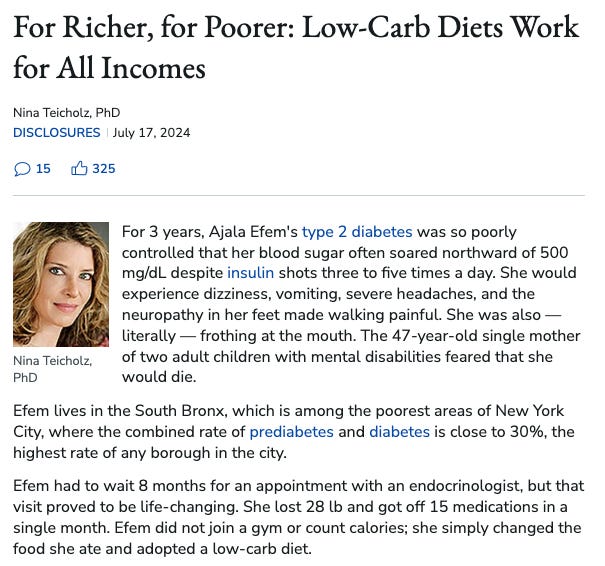
OwnaHealth, reducing suffering and cutting Medicaid Costs Consider similar benefits from metabolic health services by OwnaHealth that reduced suffering for Bronx, New York Medicaid patients, and reduced costs for private Medicaid provider Essen Health. Nina Teicholz reports in Medscape on the initial 100-person pilot program, sharing the story of Ajala Efem, a patient with poorly controlled type 2 diabetes:
Efem lives in the South Bronx, which is among the poorest areas of New York City, where the combined rate of prediabetes and diabetes is close to 30%, the highest rate of any borough in the city.
Efem had to wait 8 months for an appointment with an endocrinologist, but that visit proved to be life-changing. She lost 28 lb and got off 15 medications in a single month. Efem did not join a gym or count calories; she simply changed the food she ate and adopted a low-carb diet.
“I went from being sick to feeling so great,” she told her endocrinologist recently: “My feet aren’t hurting; I’m not in pain; I’m eating as much as I want, and I really enjoy my food so much.”
Efem’s life-changing visit was with Mariela Glandt, MD, at the offices of Essen Health Care. One month earlier, Glandt’s company, OwnaHealth, was contracted by Essen to conduct a 100-person pilot program for endocrinology patients. Essen is the largest Medicaid provider in New York City, and “they were desperate for an endocrinologist,” says Glandt, who trained at Columbia University in New York…
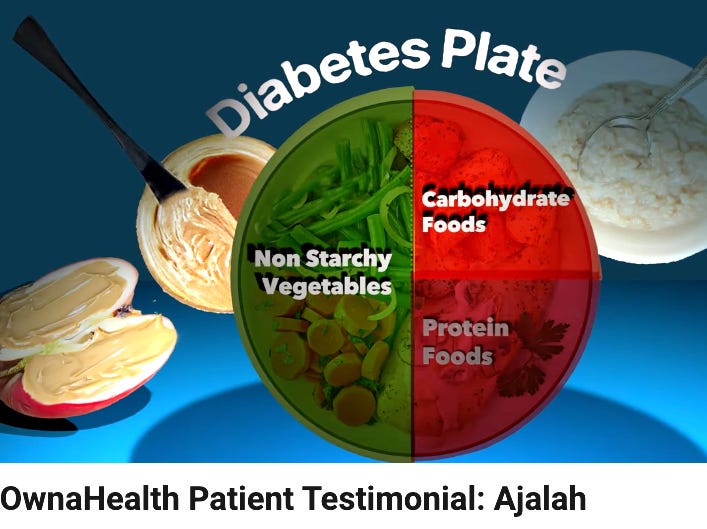
Time to Reform Standard of Care Back to the importance of reforming Standard of Care for chronic conditions like type 2 diabetes. Ajala Efem, discussed above, tells her story in this OwnaHealth YouTube video. For her condition she had been instructed by her nutritionist to manage her condition with oatmeal as part of the Diabetes Plate (in addition to many medications). Image from 2 minutes into the Ajala Efem video.
OwnaHealth is expanding to provide medical services to other New York Medicaid providers, which will continue to reduce suffering, as well as medications, saving money for cash-strapped Medicaid. How many others on Medicaid struggling with obesity and type 2 diabetes are still advised to stay with high-carb Diabetes Plate and stuck multiple medications (including insulin needles)?
If instead more private Medicaid providers subcontract with OwnaHealth and similar metabolic health focused firms, their metabolic Standard of Care will reduce suffering, medications, and also cut health and insurance costs.