
Adventures in Terraforming: Going Green with Turtles, Beavers, Buffalo, Elk, and Cattle
Animals can convert Earth’s “moonscapes” into rich green ecosystems. Past societies reshaped their environment with burning, damming streams and rivers, irrigating, as well as hunting and gathering, herding animals, agriculture. and aquaculture.
Long before human terraforming, wild animals from ants and oysters to beavers and buffalo transformed their ecosystems. For beavers consider the National Park Service article Shapers of a Continent:
Before Europeans arrived, there are estimates that up to 200 million beavers lived in the area now encompassed by the lower 48 states. Imagine millions upon millions of beaver dams and ponds—each with its own rich wetland meadow and thickets. Wetlands created by beavers may have covered more than 300,000 square miles in pre-Columbian America. This means that a tenth of the total land area was rich wetland—thanks to beavers—making a checkerboard pattern of ecological diversity across the face of the continent and creating homes for a large number of species, including insects, amphibians, fish, birds, and mammals.
Then French trappers arrived to transform this environment, providing hundreds of thousands of beaver pelts each year to Europeans. Millions of beaver pelts from the 1600s to 1900s. Without beaver dams to slow water flows, these lands transformed.
Beavers are still busy transforming streams to ponds and wetlands where they get the chance. Even in the Nevada desert. One of many YouTube videos (Nevada Turned A Dead Desert Creek Over To Beavers… 14 Years Later The Water Came Back) reports on beavers slowing stream flows to restore (or create) “deep pools, dense willows, and a wide green floodplain that stays wet through some of the worst drought years on record in the driest state in the United States.”
From Beavers Slowing Streams to Buffalo Breaking Soil
Farmers struggle with flooding and droughts (and with taxes, tariffs, and regulations). But droughts and flooding are two sides of the same coin. Nature provides rain but rain can pour down too much and too little. Lush vegetation and open ground welcome heavy rain, absorbing many inches to flow deep into the soil with some seeping further down into aquifers, underground rivers that slowly flow hundreds of miles.
In the news most years are stories of floods and droughts in Texas. Cattle and buffalo can come to the rescue, enriching and breaking up soils to absorb more water, reduce flooding and delay droughts.
Animal herds, ruminants especially, break open soils as well as fertilize (many online videos discuss multi-paddock cattle grazing to support soil roots and microbes, water retention, and cooling). In the Texas hill country cattle and buffalo herds provide the benefits of past roaming buffalo to support prairies with deep-rooted, water-welcoming soils.
Many Texas regenerative buffalo and cattle enterprises to explore:

• Regenerative Ranching Is Better for the Environment, but Can It Be Profitable? (Texas Monthly, Jan 10, 2022)
• Roam Ranch (Meet A Farmer: Taylor & Katie Collins, Farmer’s Footprint, May 1, 2026))
• Katerra Exotics
…The Bierschwale family has been active in the buffalo industry since 1980 when Patrick’s grandfather, Roy, acquired his first herd on his Texas ranch. Today, Patrick and his father, Pat, operate two ranches. The original ranch is located in the Frio Canyon just outside of Leakey, TX. This is where the main production herd is located. There, the bison graze freely on hardy Texas Hill Country grasses. Our newest ranch is located in the heart of the Katy prairie. Our family lives full time on this ranch with the bison and other animals.
• Cattle story: Regenerative Grazing in the Texas Hill Country (Hill Country Alliance meeting, 2021)
Stewards of Nature: Mark and Cheryl Brown (Texas Parks & Wildlife, Aug/Sept 2023)
The Browns also put thought into their livestock management practices. The family occasionally has cattle, but not always. When the steers are there, the Browns adopt a livestock management practice called rotational grazing. By moving cattle from pasture to pasture often, the animals mimic the natural movement of bison. This allows the cattle to graze on fresh grass and allows each portion of pasture to rest and recover after grazing.
How a Texas Couple Revived 80 Acres of “Moonscape” Without Planting, Using a Dozen Cows
Elk transforming ecosystems in Appalachia
The last eastern elk were shot in the 1800s. And after, across the eastern US, forests grew to change the landscape. In Eastern Kentucky however, appeared a vast man-made elk habitat. Science Blog Aug. 30, 2026 story:
The East had grown back as dense forest and farmland, and an elk is not a forest animal at heart. It is a creature of open country, a 700-pound grazing machine built for grass.
Then the coal industry, entirely by accident, rebuilt the open country.
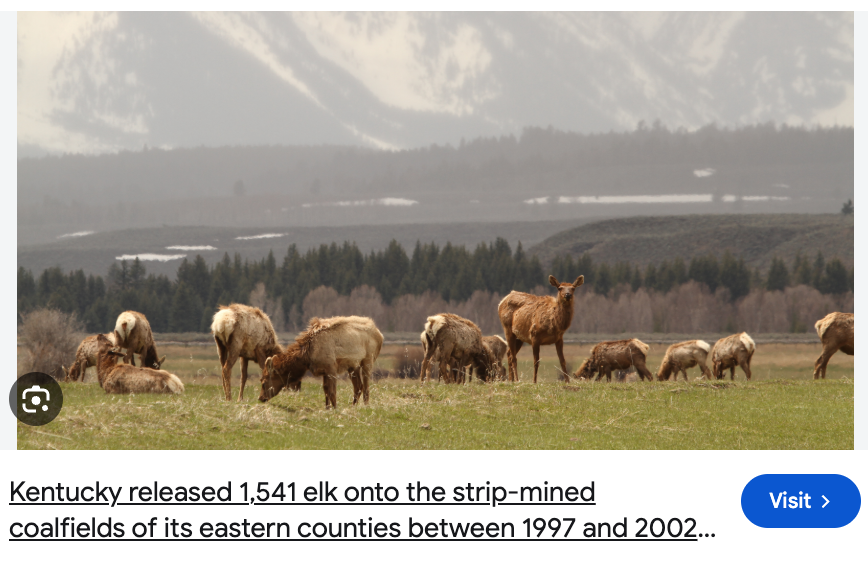
Surface mining in Appalachia does not dig holes so much as rearrange geography. Mountaintops and ridgelines across eastern Kentucky were blasted and scraped for their coal seams, and federal law required the industry to reclaim what it unmade: regrade the rubble, stabilize the slopes, and revegetate. The cheap, reliable way to revegetate crushed rock is grass, tough, fast-rooting pasture mixes seeded by the square mile.
Fifteen hundred elk were brought from the west and released across Kentucky’s reclaimed coalfields. Now the elk population is estimated at 13,000. Apart from attracting tourism and hunters, elk are transforming the grounds.
See: How to Restore a Million Acres of Strip-Mined Land? Bring in the Elk (Yes!, April 13, 2019)
“The main impact of elk is on the vegetation, although the development of soils and vegetation go hand in hand,” Franklin said. “Elk could improve the soil organic matter by defecating on the site, but at the same time, some studies have found that elk grazing can increase soil compaction and reduce some soil nutrients.
“They also bring in soil microorganisms and seeds because they frequently move between the forest and reclaimed mine site. This could help to reestablish soil biota and nutrient cycling on soils that were initially void of microorganisms after reclamation.”
A 2011 study by John Cox, a wildlife ecology and conservation biology professor at the University of Kentucky, suggested that elk are a keystone species that “act as habitat modifiers through grazing, trampling, wallowing, and uprooting of existing vegetation.”
Tortoises Terraform the Sahel: and could transform much of American Southwest
In Greening the Sahara (Medium, May 27, 2026) Suma Narayan reports on the tortoise as “ecosystem engineer”:
The Sahel region lies between the humidity of the Sudanese savanna, and the dry Sahara to the north. Temperatures veer between 60 degrees of heat, during the day and freezing, during the night. This hardens the surface soil, caking it so stiffly, that any moisture evaporates immediately. It destroyed all the efforts of researchers and authorities to try and green the space.
Enter the largest mainland tortoise in the world: the African spurred tortoise, Centochelys Sulcata. In 2021, 500 of these giants were released along the southern edge of the Sahara. And five years later, scattered green patches are making their presence felt in the desert! Satellite photographs have corroborated the results.
How did the change occur?
According to the IUCN Tortoise and Freshwater Turtle Specialist Group, these tortoises carve burrows 15 or more metres below the ground, to escape the baking heat. The burrows dig through the soil crust. Once that crust is penetrated, rainwater finds a path into the ground, rather than ‘sheeting off’.
After every rainfall, moisture stays in the ground for a longer period of time. Seeds that would stay dormant and ungerminated because of no egress into the ground, gained purchase. Later, insects and microorganisms moved into loosened soil. Vegetation, at first a patchwork, grew hardier, and thicker, near the burrow holes.
See Tortoises Turn the Desert Green: How 500 Burrowing Giants Revived Sahel Soil (Bioscience, June 23, 2026)
One of many YouTube videos on how tortoises seem to have succeeded after $19 billion of foreign-aid funding for a tree wall failed.
Could terraforming tortoises be released to help green the American Southwest? Environmentalists frown on invasive species, even with promises of environmental benefits. As a native alternative consider this Colossal news:
The Colossal Foundation, the 501(c)(3) charitable organization associated with Colossal, the de-extinction company, announced a $500,000, five-year partnership with the Turner Endangered Species Fund (TESF) to accelerate recovery of the Bolson tortoise (Gopherus flavomarginatus), North America’s largest and rarest tortoise species, within its prehistoric range, marking a critical advancement for Pleistocene rewilding efforts. (PR Newswire, Nov. 13, 2025)
Sinking the Rain
A discussed above, farmers and ranchers face challenges from rains too heavy then too rare (so floods and droughts). Beavers slow water flows creating ponds and wetlands, and turtles, elk and other ruminants break up soils to allow far more rain to seep into soils, for plants and microbes to flourish.