NSDA and UIL debaters can find myriad books, articles, and videos offering policy reforms for the federal health insurance topic. Discussion here will draw from economic principles: opportunity cost, supply and demand, substitutes and trade-offs, incentive and information problems, special interests (factions), and regulatory capture. Central to thriving communities and societies are economic freedom and sound legal institutions open for entrepreneurs and enterprise. But that doesn’t describe today’s food, public health, medical care, and health insurance institutions, policies, and practices. All are heavily regulated by local, state, and federal government agencies. And those government policies are influenced by major food, medical, and health insurance companies and associations.
A healthy economy depends upon healthy people, of course. But most Americans aren’t healthy. Americans live longer than they used to, have longer lifespans, but many have reduced healthspans, that is, they suffer more from chronic disease through those additional years. The elderly are more susceptible to infectious disease. How much have misguided federal health care and insurance policies contributed to poor metabolic health for elderly Americans? Seventy-five percent of the deaths during the COVID-19 pandemic were those 65 or older, and over fifty percent over 75. Influenza deaths are also far higher among the elderly. Poor metabolic health (and low vitamin D levels), not just age, contribute to mortality among the elderly.
Health (and health insurance) costs from poor metabolic health Most Americans are metabolically unhealthy now, and most chronic health problems follow years or decades of poor metabolic health:
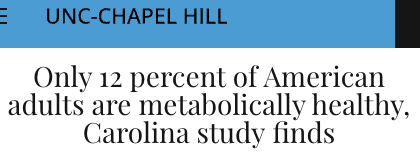
…only 1 in 8 Americans is achieving optimal metabolic health, which carries serious implications for public health. Poor metabolic health leaves people more vulnerable to developing Type 2 diabetes, cardiovascular disease and other serious health issues.
The study presents the most updated United States data on metabolic health, which is defined as having optimal levels of five factors: blood glucose, triglycerides, high-density lipoprotein cholesterol, blood pressure and waist circumference, without the need for medications.
Public health authorities, government policies, food and health care industry practices (and prescriptions) have all contributed to these escalating health problems and costs. US health care is nearly half-funded by federal, state, and local governments (43-47% in this 2016 journal article). This July 23, 2026 Congressional Budget Office document begins: “The federal government subsidizes health insurance for most Americans through various programs and tax provisions.”
The Coalition supports CMS’s [Centers for Medicare & Medicaid Services] efforts to better integrate prevention, nutrition, lifestyle interventions, and longitudinal care into Medicare payment policy. The Coalition respectfully submits comments on Medical Nutrition Therapy (MNT) and Diabetes Self-Management Training (DSMT), intensive lifestyle interventions for Alzheimer’s disease and related dementias, primary care redesign, health and well-being coaching services, and Shared Medical Appointments. [Source]
Today, UPFs make up over 70% of the food items in a typical grocery store. Government policies – most notably subsidies on corn and other grains – incentivize increased production of high-fat meat and dairy products, seed oils, processed grains, sugar-sweetened beverages, and processed foods. The availability of cheap substandard ingredients influences food production practices that are not aligned with good nutrition. Moreover, processed food manufacturers manipulate foods to be hyper-palatable and have long shelf life, thus increasing UPF’s allure and affordability. These less nutritious food options are not obviously unhealthy – changes to food processing methods that make the standard American diet dangerous are often invisible to the consumer and are cloaked with sugar, salt, flavorings, and chemicals to make the food especially appetizing..
For links to books, published research, and podcasts on food, nutrition, and metabolic health, see NormalNutrition.substack.com posts.
Subsidizing health care demand and regulations limiting supply Federal Medicare and Medicaid programs (and later the Affordable Care Act) increased demand for medical services but kept regulations that slowed or blocked new medical schools and hospitals (and limit foreign-trained doctors and nurses). Supply constraints combined with demand subsidies will of course raise prices (and raise doctor and hospital incomes).
AI Overview: … Following the passage of Medicare and Medicaid in 1965 under President Lyndon B. Johnson, American physicians experienced a massive, unprecedented spike in their average earnings.
[and] This rapid rise in healthcare costs eventually forced a reckoning. By the late 1980s and early 1990s, the federal government stepped in to curb spending, passing the Omnibus Budget Reconciliation Act of 1989 (OBRA 89). This law abolished the open-ended fee model and introduced a rigid Medicare Fee Schedule, which placed strict limits on how much doctors could bill. [1]
Today, the dynamic has reversed: when adjusted for inflation, Medicare physician reimbursements have actually declined by over 33% since 2001, leading to modern friction between providers and the federal government. [1]
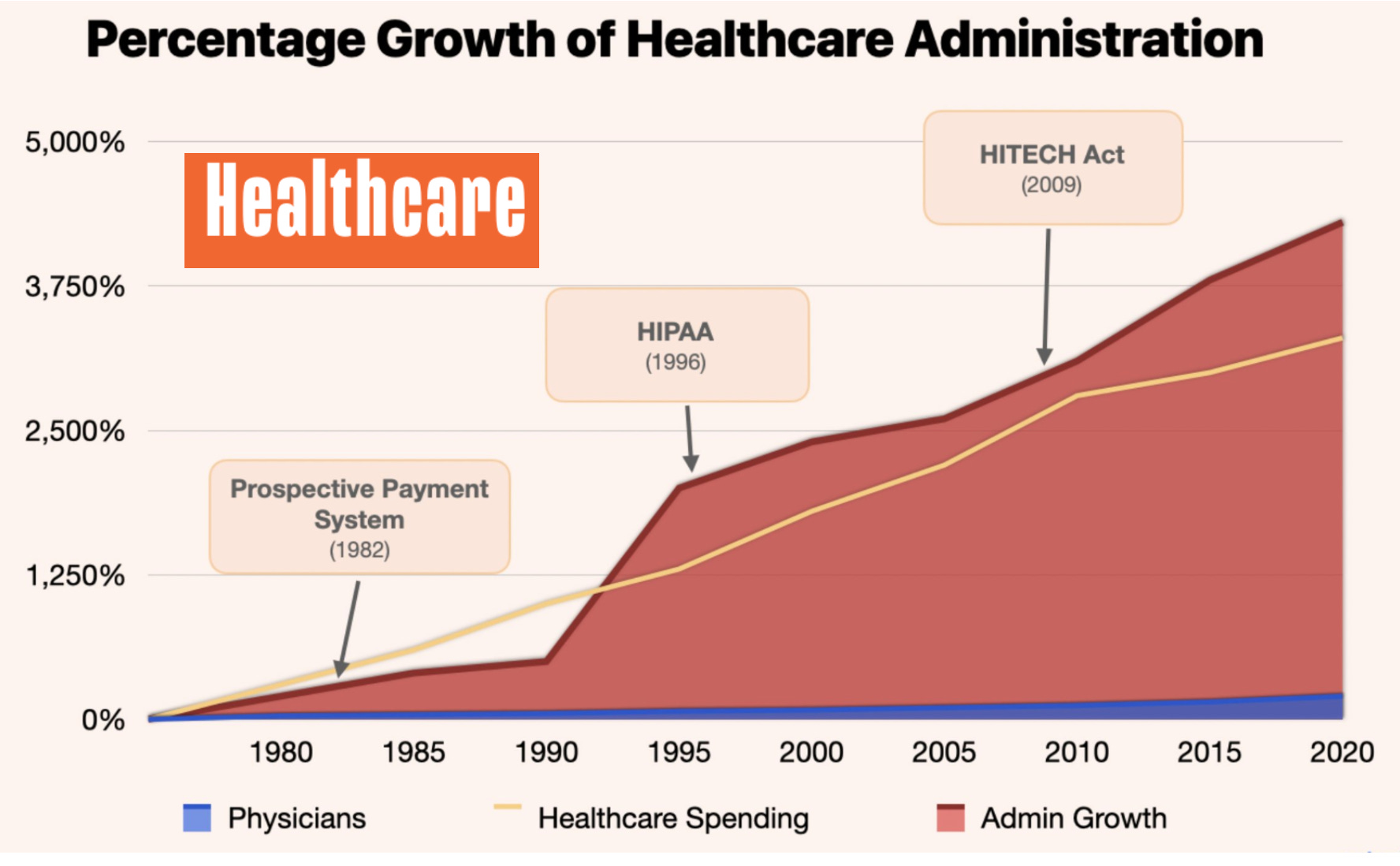
Federal regulators trying to hold down costs led to endless unintended consequences. One major consequence has been a vast increase of health and medical care managers tracking costs and rejecting or approving medical procedures (for private as well as federal health insurance).
Private Equity and Consolidation: Starr documented how medicine transitioned from independent practitioners to organized entities. Today, this applies to the massive wave of private equity firms, large hospital conglomerates, and insurance giants buying up independent physician practices. [1, 2]
Loss of Physician Autonomy: Doctors once held absolute professional sovereignty. Today, many face administrative oversight, algorithmic management, and employment by massive corporate healthcare networks rather than running their own local clinics. [1, 2]
Insured to Death vs. The Oregon Experiment (Medicaid for All lottery) Apart from problems from overregulation (or under-regulation) of physicians and health insurance, are challenges calculating costs and benefits for medical procedures and prescription drugs. Ideally, societies allow doctors and patients make decisions together on surgeries, other medical procedures and devices, and prescription drugs. However, with America’s current system, most procedures and prescriptions are paid for by third parties, either the federal government, health insurance companies, or companies that self-insure for employee health coverage.
The 2025 book Insured to Death: How Health Insurance Screws Over Americans – And How We Take It Back, profiles stories of Americans suffering and dying when procedures doctors order are denied by insurance companies. The book says insurance companies profit when claims are denied, and references a 2022 study showing insurance companies spent $25.7 contesting claims ($57 in administrative costs per denied claim). American physician practices spend $83,000 in billing-related costs per physician, four times more that in Ontario, Canada (page 70). Some 15% of US health care costs are for administration, not delivery of health care.
That’s the seen, but what’s unseen in this narrative? How do we measure the health costs of drugs not taken or procedures not done due to review and rejection by health care insurers? How many of today’s medical procedures and prescriptions actually work as advertised? (And: “U.S. pharmaceutical and healthcare industry spends between $30 billion and $48 billion annually on total marketing and advertising” (source).
This randomized, controlled study showed that Medicaid coverage generated no significant improvements in measured physical health outcomes in the first 2 years, but it did increase use of health care services, raise rates of diabetes detection and management, lower rates of depression, and reduce financial strain. …
Despite the imminent expansion of Medicaid coverage for low-income adults, the effects of expanding coverage are unclear. The 2008 Medicaid expansion in Oregon based on lottery drawings from a waiting list provided an opportunity to evaluate these effects.
Approximately 2 years after the lottery, we obtained data from 6387 adults who were randomly selected to be able to apply for Medicaid coverage and 5842 adults who were not selected. Measures included blood-pressure, cholesterol, and glycated hemoglobin levels; screening for depression; medication inventories; and self-reported diagnoses, health status, health care utilization, and out-of-pocket spending for such services. We used the random assignment in the lottery to calculate the effect of Medicaid coverage.
We found no significant effect of Medicaid coverage on the prevalence or diagnosis of hypertension or high cholesterol levels or on the use of medication for these conditions. Medicaid coverage significantly increased the probability of a diagnosis of diabetes and the use of diabetes medication, but we observed no significant effect on average glycated hemoglobin levels or on the percentage of participants with levels of 6.5% or higher. Medicaid coverage decreased the probability of a positive screening for depression (−9.15 percentage points; 95% confidence interval, −16.70 to −1.60; P=0.02), increased the use of many preventive services, and nearly eliminated catastrophic out-of-pocket medical expenditures.
For affirmative debaters advocating Medicaid for All national insurance, this study is a major challenge. If current medical care is unhelpful and costly, reforming Standard of Care for many chronic conditions should come before or with national health insurance.
My take on the study: those who secured free health insurance and care (Medicaid) via the lottery received care and advice that was unhelpful or even harmful (treating symptoms of chronic conditions, not causes). As an example, for those with type 2 diabetes and pre-diabetes, prescribing drugs and insulin is less helpful for most than dietary changes (cutting sugar, carbs, and Ultra Processed Foods in general) and monitoring blood glucose with CGMs (Continuous Glucose Monitors). One of many thoughtful CGM articles: 6 things I learnt from wearing a glucose monitor as a dietitian (Myota Health, July 10, 2025)
Here is BMJ Journals update: The diet that rewrote the rules on type 2 diabetes remission references this 2023 journal article by Dr. David Unwin reporting on patients drug-free remission of type 2 diabetes with dietary changes (some 150 patients so far). Is dietary change and checking blood glucose levels the type 2 diabetes Standard of Care for Medicare, Medicaid, and Veterans? (No.) That is a major reason the Medicaid for All experiment in Oregon failed to deliver measurable health benefits.
Evidence-based Medicine? How much of today’s medical care is based on science, that is, on evidence that the procedure or medication is effective, that the benefits outweigh side-effects, risks (and costs). Again, economics is about incentives, and with third party payments, doctors, hospitals, medical device makers, and pharmaceutical companies all earn income for procedures and prescriptions paid for by third parties (governments and private health insurance providers). Doctors can believe in the effectiveness of the procedures and medications they prescribe. But that doesn’t make procedures and medications effective and beneficial. They might be, they might not be. Benefits have to be measure and judged against costs, potential risks and side-effects.
For the $30 billion to $48 billion spent each year advertising and marketing medical procedures and medications, how much encourages excess medical care that is actually harmful (as well as costly)?
Consider the case of four Redding, CA doctors whose heart surgeries were praised as effective (fewest deaths and side-effects). The reason their Redding Medical Center heart procedures were so successful turned out to be that they were unnecessary. (See Doctors to pay $32.5 million to settle unnecessary-surgery case (SFGate, Nov 15, 2005) and FBI investigates cardiac surgeries. FromThe BMJ, Nov 2002):
The FBI, in an affidavit supporting its raid on the doctors’ offices, said it was gathering evidence as part of an investigation into claims that the two doctors performed hundreds of unnecessary invasive procedures, such as cardiac catheterisations, coronary bypasses, and heart valve replacements, to make money from Medicare, the federal government’s health scheme for people aged over 65.
As many as a quarter to a half of the procedures may have been unnecessary, the federal affidavit contends. Despite many warnings over the years, hospital officials chose to ignore concerns raised by other doctors and a patient…
How prevalent are unnecessary surgeries and medications paid for by Medicare, Medicaid, and private insurance companies? Back and spine surgeries? 17%-51% (Carrumhealth). Cardiac pacemakers? Up to 22%. Students should do their own research. A malpractice legal firm (gislaw.com) claims:
• Cardiac angioplasty or stents: often done when patient is not suffering acute heart attack symptoms. Studies have found up to 12 percent of these procedures are unnecessary.
• Pacemakers: In up to 22 percent of cases, researches found no medical justification.
• Back Surgery: Up to 17 percent of back surgeries are performed without abnormal neurological or radiological findings.
• Hysterectomy: Studies found hysterectomies were improperly recommended in up to 70 percent of cases, even though there were non-surgical alternatives.
• Knee/Hip replacements: A study found that when patients received information on alternative therapies, there was a 26 percent reduction in hip replacements and a 38 percent reduction in knee replacements.
So… it is worth remembering that when health insurance companies deny claims, they are sometimes protecting patients from unnecessary and often painful procedures, as well as trying to save money.