
Reforming Medicare and USDA Dietary Guidelines
In presentations for the agriculture policy debate topic last week I argued that USDA Food and Nutrition dietary guidelines, though improved from earlier versions, still misleads most Americans.
And in talks the week before to Texas UIL policy debaters with national health insurance as their debate topic, I argued USDA Food and Nutrition dietary guidelines, though improved from earlier versions, still mislead Americans, significantly increasing health care and health insurance costs (and human suffering).
The new USDA Food and Nutrition dietary guidelines cover page enlarges “meat, dairy & healthy fats,” on the top left of the inverted pyramid, and has “Vegetables & Fruits” on the top right. Page one leads with “prioritize protein” from “animal sources, including eggs, poultry, seafood and red meat, as well as a variety of plant-sourced protein foods…” So that’s a good thing, aligning the dietary guidelines to high-quality nutrition research.
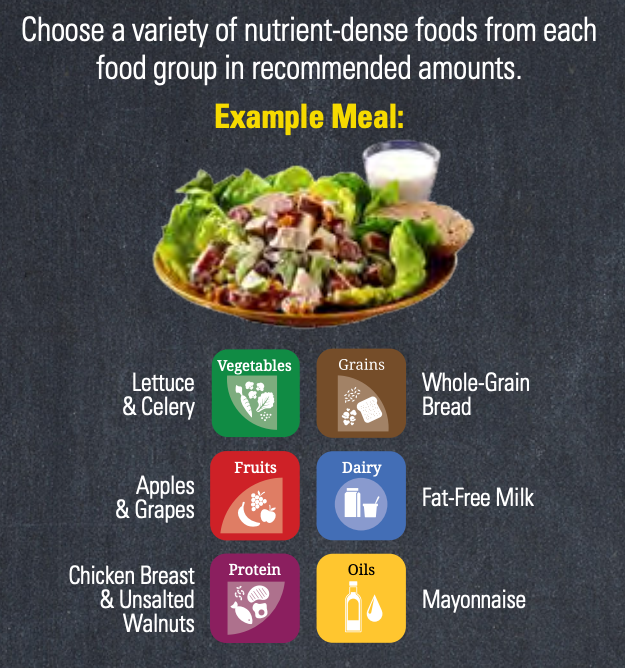
In contrast, the 2015-2020 dietary guidelines categories (page xv) start with “Lettuce & Celery,” then “Whole-Grain Bread” then “Apples & Grapes,” “Fat-Free Milk,” and finally some meat: “Chicken Breast & Unsalted Walnuts” followed by “Mayonnaise.”
What is in the white container: mayonnaise or maybe fat-free milk? Skim milk has about half the calories of whole milk but whole milk has the advantage of providing greater satiety. “The natural fat in whole milk slows digestion and helps you feel full longer, which may prevent snacking or overeating later.” And “Fat-soluble vitamins (like vitamins A, D, E, and K) are better absorbed by the body when consumed alongside dietary fat. [1, 2]” And for most, managing hunger matters more than managing calorie.
Page 2 of new and improved 2025-2030 Dietary Guidelines still leads with “Eat Vegetables & Fruits Throughout the Day” and after “Incorporate Healthy Fats” instructs to “Focus on Whole Grains.”
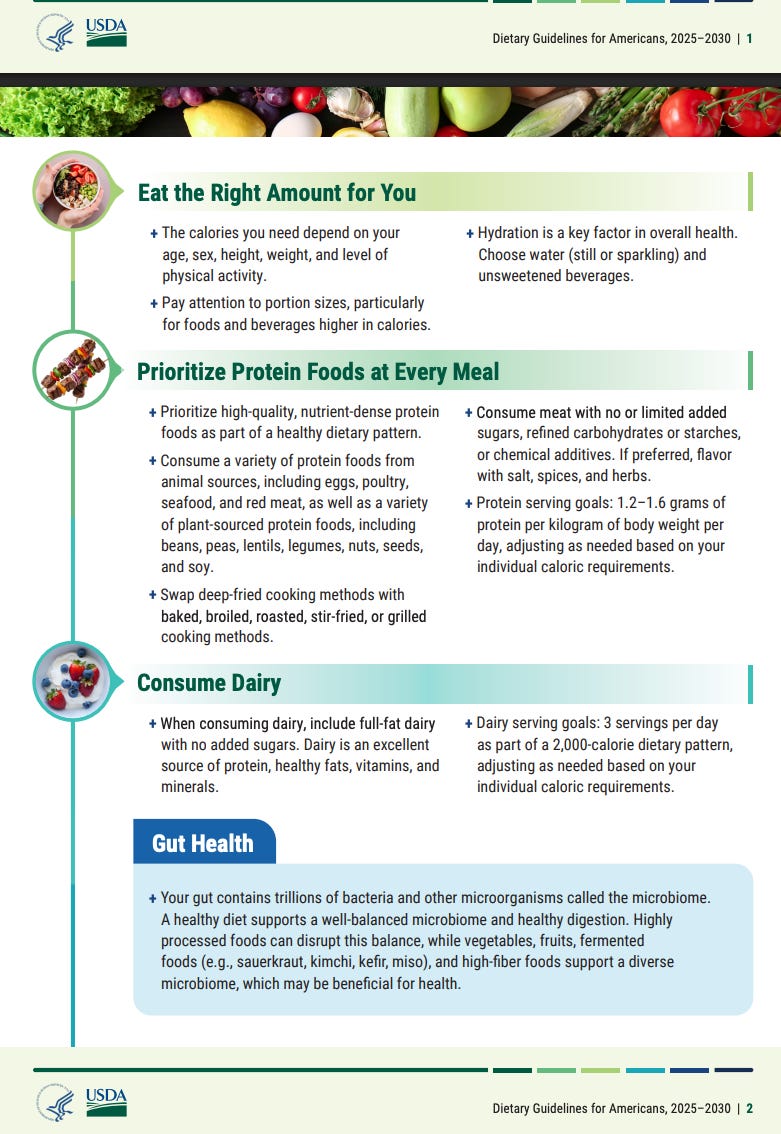

Again though, the majority of American are already metabolically unhealthy (see this 2018 Univ. of North Carolina study), and most are better off not eating vegetables and fruit “throughout the day.” Have meals at mealtimes and avoid high-carb starchy vegetable and high-sugar and fructose fruits. For further discussion, see the American Diabetes Society (ADS) website, whose advice sits opposite advice from the industry-funded American Diabetes Association. The ADS advises restricting carbohydrates to reverse (or put into remission) type 2 diabetes. It’s not complicated, why not mention cutting carbohydrates as a first step to regain metabolic health?
Good luck trying to identify American Diabetes Association (ADA) funding sources with Google search (I couldn’t). But a Grok Bot request returned:
Drug and device makers are a big part of the [2025 ADA] donor list. Abbott, Eli Lilly, Novo Nordisk, Boehringer Ingelheim, MiniMed and the CDC each gave $1M or more in 2025, and Sanofi, Amgen, Bayer and Vertex each gave $500K to $1M. The ADA’s own 2023 disclosure of pharma and device revenue lists $24.8M that year, about 17% of revenue, led by Lilly at $7.3M, Abbott at $6.4M and Novo Nordisk at $2.7M….
A 2006 New York Time focused on ADA funding from the food and pharmaceutical industries: In Diabetes Fight, Raising Cash and Keeping Trust:
They say the A.D.A. remains too wedded to benefactors in the food and pharmaceutical industries, who provided more than $23 million last year.
Of particular concern: a three-year, $1.5 million sponsorship deal with Cadbury-Schweppes, the world’s largest confectioner. Under the deal, which meets the new guidelines, Cadbury is promoted as an A.D.A. sponsor in several settings, and has permission to use the A.D.A. logo on its Diet-Rite sodas, Snapple unsweetened tea and Mott’s Apple Sauce, among other products.
Critics say the A.D.A. affiliation has helped Cadbury pose as a concerned corporate citizen, even as it supplies grocery stores with sugary and fattening foods like Dr Pepper and the Cadbury Creme Egg.
“Maybe the American Diabetes Association should rename itself the American Junk Food Association,” said Gary Ruskin, director of Commercial Alert, a consumer advocacy group.
Nina Teicholz is critical of American Diabetes Association advice (and funding) in her 2024 post: The American Get-Diabetes Association (Unsettled Science, March 22, 2024):
Twitter (X) has gone wild in recent days about a video–now viral at 1.9M views–by the new Director of Nutrition & Wellness at the American Diabetes Association (ADA), Stacey Krawczyk, employing a treacly, first-grade-teacher voice to explain how to fill up a 9” plate with green veggies (½ the plate), lean proteins (¼) and the remaining ¼ as “starchy vegetables, rice, pasta, bread.” This last category of carb-rich foods elicited 282 feisty comments, 100% negative. Quite a few wondered the obvious: why tell diabetics to eat starches (carbohydrates) when one could well define diabetes as simply a condition of carbohydrate intolerance?
What we eat, when we eat, and how much we eat matters for our health, as does staying active, getting enough sunlight, saturate fat, and salt, enough sleep, and dealing with stress. Cutting or reducing sugars and carbohydrates should be natural advice to try first before prescribing drugs, injections, or surgery.
Status quo diet and nutrition recommendations are the current USDA policies and programs. And reforming these mostly misguided dietary recommendations are key to reducing health care and insurance costs. Nutrition and dietary reforms stand at the intersection of both the Stoa league agriculture topic and the NSDA/UIL national health insurance topic.