
Food, Farming, Politics, and Economics
Ideally food and farming wouldn’t be political. Decisions about how food should be grown or raised, processed, and provided wouldn’t be left for politicians and citizens to cast votes. As consumers, decisions about how and where we purchase food wouldn’t be “nudged” by special interest groups or regulated, subsidized, and taxed by local, state, and federal government officials.
Consider this article: The True Cost of a Hamburger (Daily Economy, April 20, 2022) which claims the USFG “spends $38 billion every year subsidizing the meat and dairy industries.” The link is broken but I’m guessing it went to Removing the Meat Subsidy: Our Cognitive Dissonance Around Animal Agriculture (Journal of International Affairs, February 11, 2020), which begins with then candidate Elizabeth Warren passing on meat and attacking fossil fuel industries:
At this fall’s “Climate Crisis” town hall forum on CNN, Democratic front-runner Senator Elizabeth Warren dismissed the idea of reduced meat consumption as a simple distraction: “This is exactly what the fossil fuel industry hopes we’re all talking about… [They want to make this] your problem. They want to be able to stir up a lot of controversy around your lightbulbs, straws, and cheeseburgers.”1
On the public stage ahead of elections, these candidates were all for voters choosing cheeseburgers if they want. But the Columbia Univ./Journal of Int. Affairs) article claims this is short-sighted:
…in a time of plentiful scientific research illustrating that current trends in meat consumption will soon exceed planetary boundaries for human life, after which Earth’s ecosystems will become unstable.4 It’s why a research team from the University of Oxford recently reported that a vegan diet is the single biggest way to reduce one’s impact on the planet—far larger than cutting down on flights or buying an electric car.5 Yet rather than seize an opportunity to accurately address Americans about the negative environmental impacts of the meat industry, our elected leaders used the moment to suggest… cheeseburgers for everyone.
Apart from climate change claims, the economic claim, repeated in the AIER article, is that $38 billion in federal subsidies go “for meat and dairy industries.”:
According to recent studies, the U.S. government spends up to $38 billion each year to subsidize the meat and dairy industries, with less than one percent of that sum allocated to aiding the production of fruits and vegetables.6 [broken link] Most agricultural subsidies go to farmers of livestock and a handful of major crops, including corn, soybeans, wheat, rice, and cotton, with payments skewed toward the largest producers. Corn and soy inputs, in particular, are heavily subsidized crops for the production of meat and processed food by some of the world’s largest meat and dairy corporations. These farm subsidy programs supplement adverse fluctuations in revenues and production, and purchase farmers’ insurance coverage, product marketing, export sales, and research and development.7 This means that while shoppers pay lower immediate prices at the checkout counter, their tax dollars fund major meat operations and advertising. Meanwhile, meat and dairy producers accrue yearly retail sales to the tune of 250 billion dollars.8
The claim that subsidies for commodity crops (corn, soy, wheat, rice) are also subsidies for (some) meat and dairy producers. When federal subsidies push down the price of the corn and soy fed to animals, that reduces the cost of raising corn and soy fed animals (feed lot cattle, pigs, chicken, turkeys, sheep, and aquaculture/farmed fish).
But do those subsidies also support grass-fed, grass-finished cattle and pasture-raised chicken? No, not so much. An earlier post (The Hidden Half of Health and Agriculture) highlighted What Your Food Ate and other books contrasting regenerative agriculture and ranching from federally-subsidized industrial farm and cattle operations.

However, now in 2026 $700 million federal dollars are flowing to Regenerative Pilot Programs. Is that good news or bad news? If regenerative agriculture and ranching are valuable innovations, why should the need subsidies?
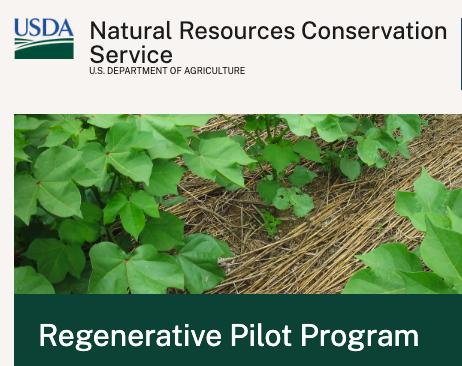
The U.S. Department of Agriculture (USDA) launched a $700 million Regenerative Pilot Program administered by the Natural Resources Conservation Service (NRCS). This initiative allocates $400 million through the Environmental Quality Incentives Program (EQIP) and $300 million through the Conservation Stewardship Program (CSP) to streamline whole-farm regenerative planning under a single application framework. (Source)