
Are Charter (and Refugee) Cities Just Theoretical?
Well, yes and no. Charter cities like Hong Kong, Singapore, Monaco, Andorra, Dubai, Lübeck, and Hamburg (and others across the Hanseatic League, Venice, Genoa, and ancient Greece) have existed through centuries. Google AI Overview notes:
Like Venice and Genoa, other major medieval trading hubs and powerful city-states in Italy included Milan, Florence, Pisa, Siena, and Verona, while Northern European counterparts known for trade and preservation include Bruges (often called the “Venice of the North”) and Tallinn, alongside walled cities like Dubrovnik, Rothenburg, and German Hanseatic cities such as Lübeck, all featuring canals, towers, or impressive fortifications from that era.
Was Hong Kong a charter city or refugee city, or both? My past post for a European Union migration topic could be revised for the South America reform topic: E.U. Migration: Hanseatic League to Charter Cities (Economic Thinking, August 1, 2020):
Hong Kong, itself a charter city, was for decades a refugee city as well, as millions fled for their lives from the brutal dictatorship and disastrous economic policies of Communist China. See The Refugee Camp with Millions of Impoverished Refugees (Economic Thinking), with link to video segment, Johan Norberg- Free or Equal – Free to Choose 30 years later 2/5
Paul Romer makes the case for more Charter Cities, more Hong Kongs and Singapores for Honduras and other countries (even Cuba!).
For a history of the path from 12th century free cities open for migrants and refugees, to European prosperity, see The Politically Incorrect Guide to Ending Poverty, The Atlantic, July/August, 2010).
Halfway through the 12th century, and a long time before economists began pondering how to turn poor places into rich ones, the Germanic prince Henry the Lion set out to create a merchant’s mecca on the lawless Baltic coast. It was an ambitious project, a bit like trying to build a new Chicago in modern Congo or Iraq. Northern Germany was plagued by what today’s development gurus might delicately call a “bad-governance equilibrium,” its townships frequently sacked by Slavic marauders such as the formidable pirate Niclot the Obotrite. But Henry was not a mouse. He seized control of a fledgling town called Lübeck, had Niclot beheaded on the battlefield, and arranged for Lübeck to become the seat of a diocese. A grand rectangular market was laid out at the center of the town; all that was missing was the merchants.
Fast-forward eight centuries…
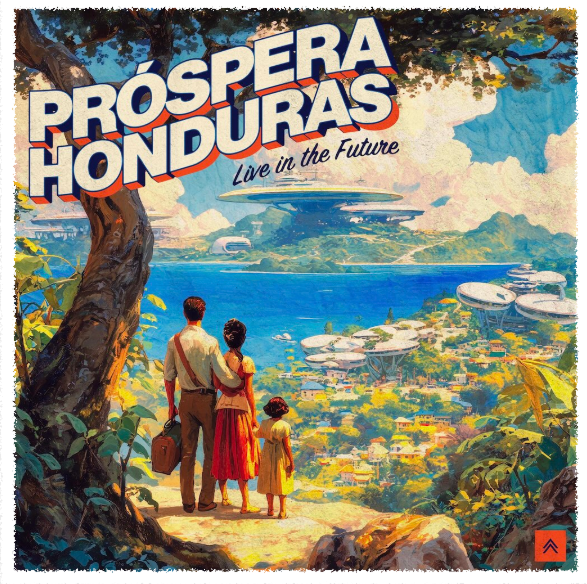
On the Atlantic side of Honduras, Próspera is prospering. “Próspera’s mission is to enable wealth creation for everyone. Poverty is an absence of wealth. Good governance enables wealth creation.” See Prospera, ZEDE Legislation and More: Charter Cities Commentary (Charter Cities Institute, May 2020)
Hong Kong… chief refugee city of the world
Hong Kong gained a 99-year charter, backed by British gun ships, from the Imperial Chinese government. Following the Communist party’s takeover of mainland China in late 1949, some two million refugees escaped to Hong Kong. Hong Kong was for decades a charter city and quickly expanded with the arrival of hard-working refugees. Economic freedom was key. A New York Times article from 1960 begins:
HONG KONG. THE “facts” about refugees in prosperous Hong Kong, perhaps the chief refugee city of the world, are simple to enumerate. This beautiful crown colony of island, jutting up from many-colored seas, of steep mountains and little valleys, covers about 391 square miles. According to the Government, about fifty of them are suitable for farming and only twelve are available for housing, business and industry. Hong Kong’s pre-war population was 800,000. Today, of its more than three million inhabitants, an estimated million and a half are the last decade’s refugees from Communist China.
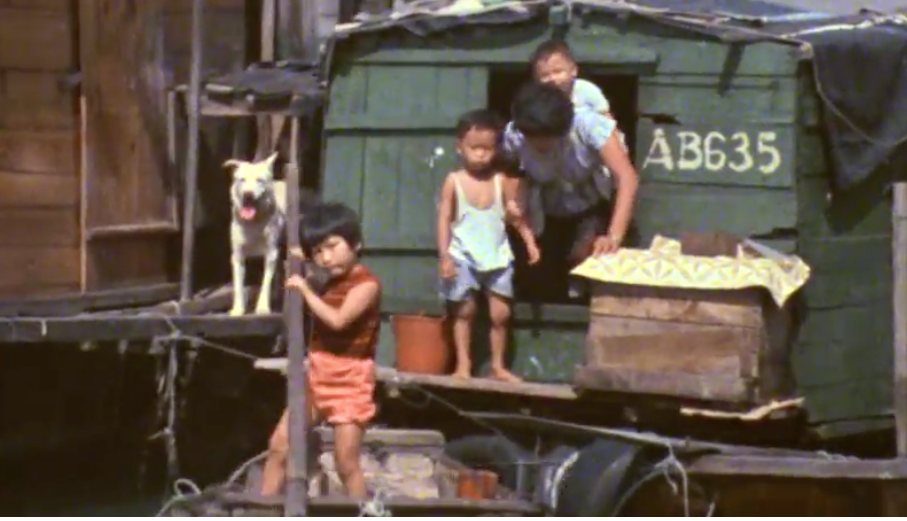
See also The Refugee Camp with Millions of Impoverished Refugees (Economic Thinking, Oct. 27, 2016). With link to Free or Equal segment on Hong Kong.
In 2020, following the communist government’s early takeover of Hong Kong, entrepreneur Ivan Ko proposed a new charter city in Ireland. From Business Insider July 28, 2020:
Ivan Ko, the founder of charter city investment company Victoria Harbour Group, formulated a plan to build a new city modeled after Hong Kong to house emigrants near Dublin’s airport. Ko’s new city, which he told The Guardian would be called Nextpolis, would house 50,000 former Hong Kong residents in a 50 square kilometer (31.07 square miles) site located between Dublin and Belfast, complete with Cantonese-speaking schools.
For more, see: Charter Cities Podcast Episode 8: Building a New Hong Kong with Ivan Ko (Charter Cities Institute, July 13, 2020)
Needed: free cities, beyond state-run refugee camps
Much of the turmoil in the United States and in across Europe follows from large-scale migration of refugees from corrupt Central and South America to the U.S., and corrupt Middle East and North Africa for Europe.
Conflicts with and government expenses for recent refugees receive wide news coverage. It’s worth noting that far more refugee suffering doesn’t make the news since most of the 117 million “people forcibly displaced” (a figure that includes refugees, asylum seekers, and internally displaced persons) don’t come to Europe or the U.S. Instead they struggle to survive in other places, hoping to someday return home. Many in camps: 4.5 million refugees in planned camps and 2 million in informal or “self-settled camps” (UNHCR and World Vision, AI Overview)
Economist Lotta Moberg proposes Refugee special economic zones (Journal of Entrepreneurship and Public Policy, 2018):
The purpose of this paper is to show how special economic zones (SEZs) can be applied to refugee camps. Zones are powerful tools for investors to act like institutional entrepreneurs, who promote institutional reform by pursuing exemptions from government constraints and taxes or by advocating for reform. Refugee SEZs (R-SEZs) would similarly allow for institutional entrepreneurs to promote broader immigration reform.
The Refugee Cities team and website make the case for host government to welcome…
Refugee cities would be special-status settlements in which refugees would be legally allowed to engage in meaningful, dignifying, and rewarding work.
Displaced people could thus provide for their families and contribute to the economic and social development of the host countries and their homelands.
Refugee cities present a pragmatic and feasible next-step solution to the problem refugees face. Rather than waiting to see if refugees will be allowed to work anywhere, refugee cities offer them the opportunity to develop their potential in a defined space now, while displaced, and in the midst of the political standstills over nationwide integration efforts.
Are Refugees a Burden or a Blessing?
Most people think of refugees as a burden for host communities, but that is more the fault of welfare states with flawed refugee policies. In reality refugees are be entrepreneurs. See Stories of Small Places: Freedom, Choice, Governance (Economic Thinking, July 26, 2020), which begins:
It’s always a good time to review, restructure, and reduce federal programs long shown to be ineffective. This includes programs for foreign aid, and foreign policy regarding international terrorism, plus legal immigration, recent national debate topics for Stoa, NCFCA, and NSDA leagues.
Stoa debaters researched federal transportation policies and advocated reforming or ending decades-old programs costing billions of dollars yet not improving transportation. A year earlier, much the same story with federal agriculture and food safety programs. Billions of dollars flowing from taxpayers through federal bureaucracies to large farm corporations and special interests (plus billions spent by consumers each year on higher-cost food and energy). …
Stoa debater next had a topic on foreign aid, so researched the aid industry, which, for NCFCA debaters, claimed also to be reducing international terrorism. Diverse foreign aid and international terrorism programs emerge from a web of interconnected government agencies, corporations, consultants, and nonprofit aid groups, most with intentions to make the world safer and more prosperous.
However, students again found dozens or hundreds of federal programs had gone off the rails over the years, consuming time and taxpayers dollars with little or no progress reducing terrorism nor helping millions stuck living their lives in poor countries and refugee camps worldwide.
Refugee camps can be hubs of entrepreneurship, as this Oxford Refugee Economies in Uganda report notes:
Consider the market-based refugee camp profiled in Refugee Economics in Uganda: Challenging Popular Myths about Refugee (Oxford Refugee Studies Centre, 2014) and their 2016 book Refugee Economies: Forced Displacement and Development. Instead of taking millions in handouts from international aid agencies and charities, Uganda’s Self-Reliance Strategy protects refugees rights and opportunities for enterprise:
It focuses on the case of Uganda because it represents a relatively positive case. Unlike other governments in the region, it has taken the positive step to allow refugees the right to work and a significant degree of freedom of movement through its so-called ‘Self-Reliance Strategy’. This allows a unique opportunity to explore what is possible when refugees have basic economic freedoms. The book shows that refugees have complex and varied economic lives, often being highly entrepreneurial and connected to the global economy. The implications are simple but profound: far from being an inevitable burden, refugees have the capacity to help themselves and contribute to their host societies if we let them.
So… for debaters with the US/Central and South America reform topic, are Refugee Cities just theory or are they opportunities to draw from historical reality to provide economic freedom opportunities for millions today? Presentations on past E.U. immigration topic can apply to Central/South America migration reforms and opportunities.
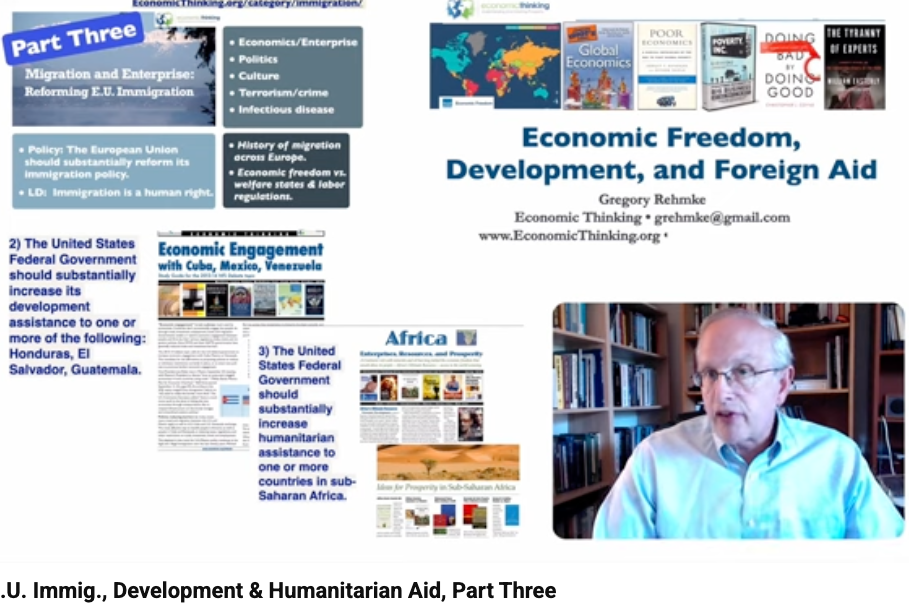
• E.U. Immig., Development & Humanitarian Aid, Part Three (EconomicThinking Youtube).
• Econ. of E.U. Immig., Development and Humanitarian Aid Part Four (EconomicThinking Youtube)