
For Central and South America: Who Decides on Energy Sources?
Economies burn energy, and so do plants, animals, and people. Energy for homes, factories, and fisheries is big business, and so is food for animal and human energy. Students gain insight into energy policy and politics researching competing supply ecosystems for the food industry. Ranchers, pig farmers, chicken producers, and commercial fisheries compete, much as natural gas, oil, coal, nuclear, hydro, wind, and solar industries compete.
An astonishing variety of articles and studies are published each month on new wind, solar, hydro, nuclear, geothermal, and natural gas technologies. Advances and research findings are reported (often by press release) on battery, and other energy storage and carbon capture advances. Every day the energy race unfolds.
Press reports regularly claim “game changing” breakthroughs, amazing cost advantages, and often predict the “end of coal.” Fossil fuel investors are advised to head for the exits. Other articles complain about (or endorse) wind and solar subsidies or fossil fuel subsidies. Other articles debate utility monopolies and micro-grid regulations.
Competition and cooperation are central to market economies. Across energy companies large and small, entrepreneurs and engineers cooperate and compete as do marketing, communications and public relations teams. Each energy source depends upon networks of companies, suppliers, employees, investors, production and delivery infrastructure, plus business associations, lobbyists, and legislator advocates (bought critics claim, or at least rented).
Students researching energy policy read conflicting studies and claims about wind, solar, natural gas, hydro, geothermal, and nuclear energy. These academic, media, and political stories highlight competing public relations efforts from energy industry ecosystems and from environmental organizations battling each other.
Consider Reframing Energy for the Age of Electricity (Ember, 17 Feb 2026). The authors say wind and solar energy is more efficient in delivering value to customers. Fossil fuel advocates insist there is more wasted energy in the wind and solar production and delivery, plus they need energy storage and reliable energy for back-up (plus don’t generage energy on cloudy and calm days and nights).
One way to think about energy technology ecosystems is to compare them to food and nutrition, the energy for the body.
So maybe pigs are coal, beef is oil, chickens are natural gas, turkeys hydro, and solar power can be vegetarian and wind vegan. It should be no surprise that pig farmers and processors push pork as food energy, while cattle ranchers promote beef and chicken farmers see chicken as superior.
Each food energy source is big, big business, creating value for consumers, jobs for producers, income for suppliers, and profit (or loss) for investors. And each industry generates pollution and other externalities.
Each issue of “Beef Weekly,” “Pork Digest,” and “Chicken Today” is replete with articles praising beef, pork and chicken. Industry associations fund research on the benefits of what they produce, plus fund research to counter the claims of food competitors.
Just as entrepreneurs across the food chain develop new technologies to increase efficiencies to lower costs, so do entrepreneurs in the energy world.
All food and energy sources involve tradeoffs. Each has benefits and costs, with supporters and critics. Ideally federal policies toward food production would be minimal and offer a level playing field for companies. Politicians and state bureaucracies can be enlisted to subsidize research and production of food (farm subsidies and agriculture research for example), and can protect or damage via state and federal regulations (more or less regulations on pollution from factory pig, chicken, cattle, and fish farming, for example).
Similar subsidy and regulatory conflicts surround energy production, distribution, and consumption. So students debating energy policy shouldn’t be surprised to find conflicting news stories and studies that disagree about wind, solar, hydro, nuclear, natural gas, oil, and coal benefits and dangers.
Environmental and climate research, studies, and news stories add complexity to the competition. Not everything is at is seems. Articles citing research critical of solar energy are sometimes funded by wind energy associations. The natural gas industry sometimes funds research and articles critical of coal energy. As “big coal” declines, natural gas companies expand market share.
Who opposes electricity from hydro? Natural gas companies form PAC to fight CMP’s transmission corridor (Bangor Daily News, December 19, 2019):
Two national companies that operate natural gas plants in Maine are stepping into the fight over Central Maine Power’s power line proposal for western Maine. They’ve created a political action committee supporting a potential ballot question aimed at killing the CMP [Central Maine Power] project.
Flumerfelt acknowledged that the injection of electricity from Hydro-Quebec’s dam system into this region via the CMP transmission line would suppress electricity prices enough to hurt the company’s bottom line.
Natural gas companies opposing transmission lines from distant hydropower shouldn’t be surprising. A broader public relations strategy has been to fund “grassroots” and environmental opponents of major energy projects like the CMP. Similar stories are common across the food and energy industries. A 2016 Forbes article asks Are Fossil Fuel Interests Bankrolling The Anti-Nuclear Energy Movement? and a 2012 article in Time reports: Exclusive: How the Sierra Club Took Millions From the Natural Gas Industry—and Why They Stopped [UPDATE].
[And for those wanting to pursue the food fights, see: THE BIG FAT SURPRISE Why Butter, Meat & Cheese Belong in a Healthy Diet. A Conversation with Nina Teicholz (The Epoch Times, May 20, 2014), and 50 Years Ago, Sugar Industry Quietly Paid Scientists To Point Blame At Fat (NPR, September 13, 2016). Fighting back is: Researchers challenge claims that sugar industry shifted blame to fat (ScienceDaily, February 15, 2018)] Many nutrition posts on Normal Nutrition.
The widening gyre of energy research and advocacy encompass deeper and distant disputes: Why Renewables Advocates Protect Fossil Fuel Interests, Not The Climate (Forbes, March 28, 2019) asks:
But if solar and wind are substitutes for fossil fuels, why are the world’s biggest oil and gas firms promoting them?
Not many years ago the five largest publicly-traded oil and gas companies, ExxonMobil, Royal Dutch Shell, Chevron, BP, and Total invested a whopping one billion dollars into advertising and lobbying for renewables and other climate-related ventures.
The Forbes author, a nuclear energy advocate, makes the case that fossil fuel companies promote renewables as part of a long campaign to devalue and discredit nuclear energy. See also Why Renewables Can’t Save the Planet (Quillette, February 27, 2019).
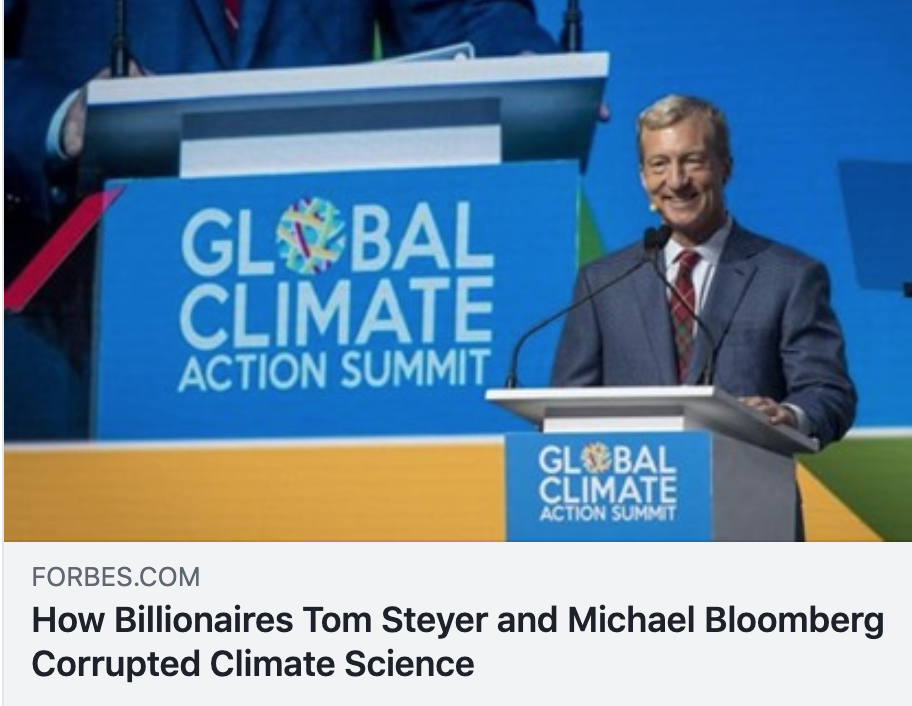
Roger Pielke tells of a research and public relations campaign funded by billionaires to shift climate science research and journalism to “Representation Concentration Pathway 8.5 or RCP8.5.” How Billionaires Tom Steyer and Michael Bloomberg Corrupted Climate Science (Forbes, January 2, 2020) makes the case that:
Over the past decade this particular scenario has moved from an extreme outlier to the center of climate policy discussions. You can read more about how that happened and its consequences in my previous columns here and here.
Before Pelke begins his climate corruption story, he notes:
Before proceeding, let’s make a few things absolutely clear. There is no doubt that climate change is real, and is significantly influenced by our activities, particularly through the emissions of carbon dioxide. I have long advocated for aggressive action on carbon dioxide emissions as well as to improve adaptation to climate variability and change. At the same time, I have also long argued that maintaining scientific integrity should go hand-in-hand with effective climate action.
And…
Today, I will add further details to this incredible story by explaining the important roles played by Tom Steyer and Michael Bloomberg, both billionaires and current Democratic presidential candidates. (Disclosure: I have endorsed publicly one of their Democratic opponents, Amy Klobuchar, but I will vote for whomever the Democrats select this November, including Steyer or Bloomberg.)
A glimpse of the story:
At the kitchen table meeting, Steyer was focused on the question: “How do you make climate change feel real and immediate for people?” He was convinced by attendees that the best way to answer this question was through people’s pocketbooks, through economics.
Following this meeting, Steyer invited two collaborators and co-funders to join him, to give the appearance of being non-partisan. One was Michael Bloomberg, then a political independent who was completing 12 years as the mayor of New York. The other was Hank Paulson, a Republican who was a former CEO of Goldman Sachs and who had also served as Secretary of the Treasury under George W. Bush.How Billionaires Tom Steyer and Michael Bloomberg Corrupted Climate Science (Forbes, January 2, 2020)
So, debaters have food for thought, electricity for light, and politics for heat. Follow the money to help untangle the story.
For debaters with the US-Central/South America topic, consider that US foreign aid and diplomacy with Central and South American countries has promoted energy policies (mostly green/renewable) and food policies (mostly critical of red meat and saturated fat) via various federal agencies and programs. Discussed in many past Economic Thinking posts…
The USFG and NGOs are eager to export their food and energy preferences to poorer Central and South Americans. From: With the U.S. off the climate stage, Latin America is ready to lead (Reuters, November 13, 2025):
Instead, new centers of gravity are emerging. In Latin America and the Caribbean, a powerful story is unfolding, one of ambitious climate action, grounded in real progress. With a cleaner energy mix than most regions, and growing momentum in renewables, green hydrogen, and corporate climate commitments, countries like Brazil and Chile are stepping up.
At COP30 in Brazil, Latin American business leaders are no longer asking whether to lead. They are asking how to scale. That is why we, a network of Latin American businesses, are using this opportunity at COP30 to call on governments to reaffirm their commitment to triple renewables by 2030.
Okay, triple renewables. At what cost to Central and South American consumers? Will energy prices and reliability for families and factories go up or down?
A separate path to prosperity in Central and South America focuses on clean, affordable, and reliable energy, whatever the source. This Wall Street Journal article profiles Energy Corps whose vision is A World Where Everyone Has the Energy Needed to Flourish.
The WSJ article title and subtitle: The Fossil Fuel Tycoon Teaming Up With the Rockefellers to Fight Energy Poverty; EQT Chief Executive Toby Rice is starting a nonprofit to tackle a lack of access to modern energy infrastructure in poor nations. From the article:
Unlike other philanthropic initiatives that emphasize renewables to energize impoverished societies, Energy Corps sees a role for a broader spectrum of solutions—from fossil fuels to solar panels and nuclear plants. …
In an interview, Rice said developing nations have benefited little from the trillions of dollars spent to combat climate change. Building energy access in a pragmatic way would boost prosperity and protect those nations from the effects of global warming,
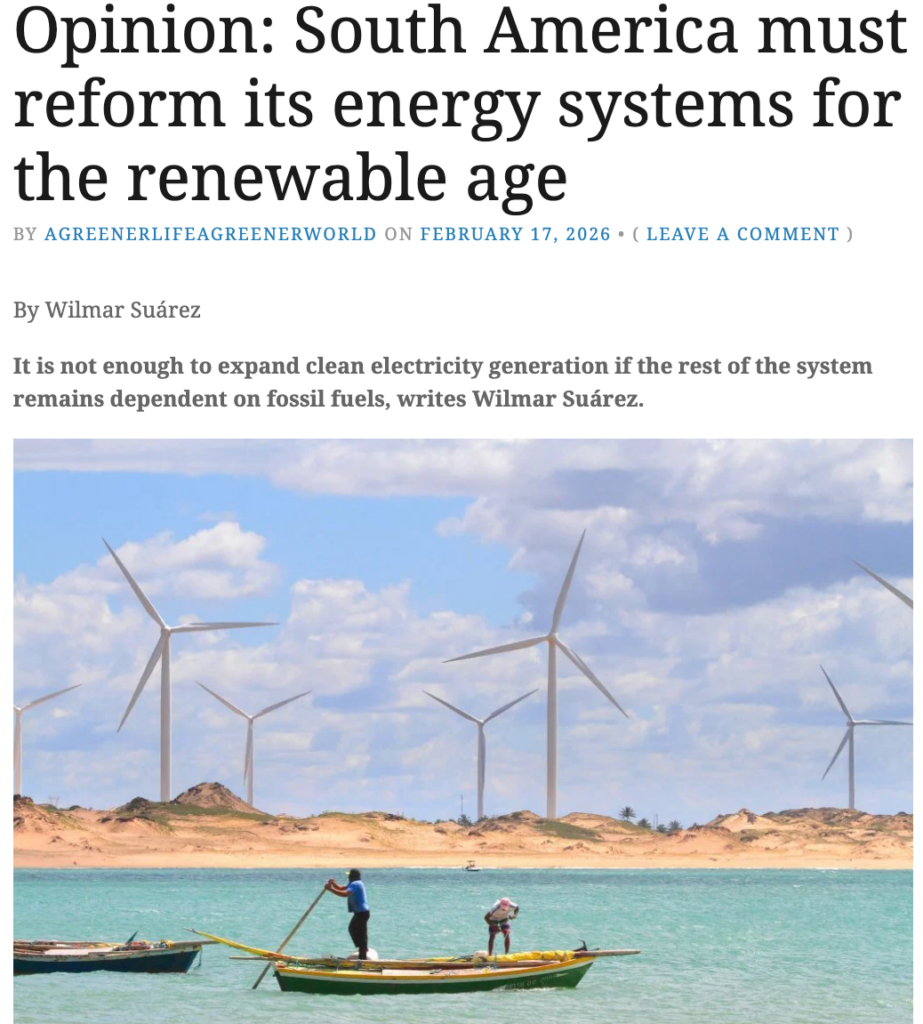
Again though, the status quo is for pushing “the renewable age” across Central and South America. An example: Opinion: South America must reform its energy systems for the renewable age (A greener life: a greener world, Feb, 17, 2026), calls for more investments in the energy transition. More wind and solar and less fossil fuels. The picture shows fishermen in Brazil with windmills in the background. It doesn’t look like these fishermen have outboard engines for their small fishing boats. They maneuver apparently with long poles. How does that work for catching fish and bringing them to shore and market, compared to an gas-powered outboard engines?
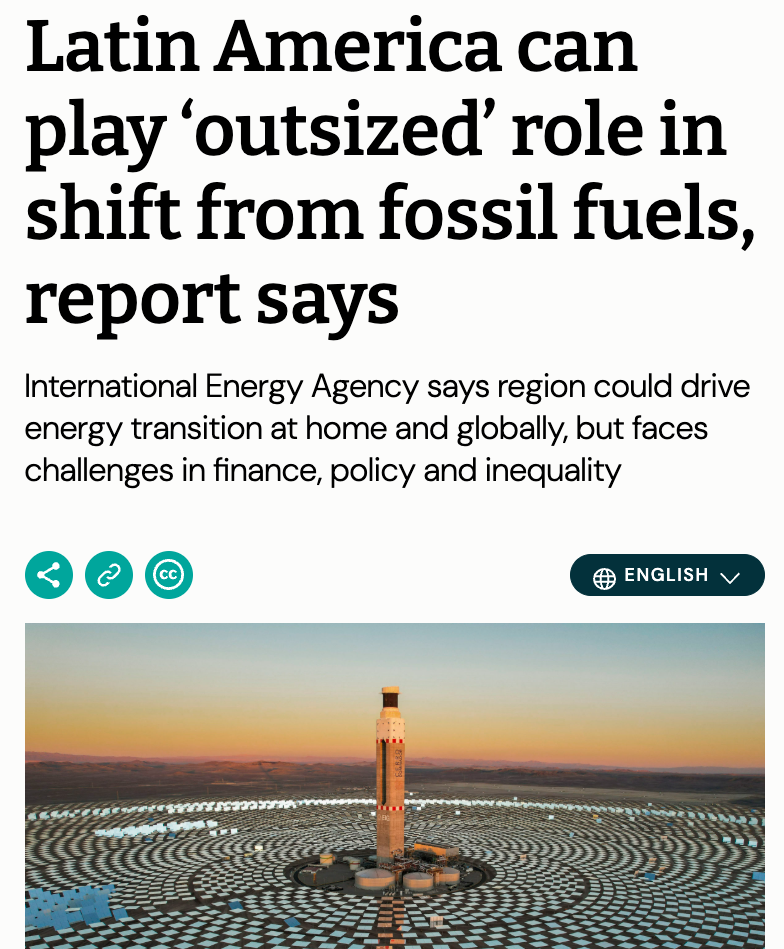
At what cost would Latin America play an “outsized” role in a global transition from fossil fuels? Is that what everyday people want? This article on a 2024 International Energy Agency report (Latin America Energy Outlook 2023), says Latin America has a “head start” in using less fossil fuels in it’s energy mix (60%, below the world average of 80%). But how much of that “head start” is just being poorer and not having access to more reliable energy to power their enterprises and households?