
Reduce Red Tape Hurting U.S. Orchards and Farms
Though most guest workers for US agriculture travel from Mexico, thousands come from Central and South America.
The WSJ Op-Ed, Red Tape Is the Biggest Crop on Some Farms (Aug. 28, 2015) reports:
The [Federal H-2A guest worker visa] program, however, is costly and onerous for farmers because of its complex requirements and paperwork. “It’s not sustainable with all the overregulation and red tape,” Mr. Smith says. The Biden administration added more than 3,000 pages of regulations to the H-2A program, according to Enrique Gastelum of the Worker and Farmer Labor Association, an organization of agricultural employers. Congress and the Trump administration could make the program more user-friendly through legislation and regulatory reform.
For the Stoa league debate topic, policy changes for H-2A guest worker visa need to significantly impact one or more Central and South American countries. Reducing the regulatory barriers and expanding the program for qualified Central and South American workers would help US farms, orchards, and ranches as well as assist Central and South America, as increased remittances flow to families and investments there.
Details (before the Biden Administration’s 3,000 pages of added regulations) here: H‑2A Visas for Agriculture: The Complex Process for Farmers to Hire Agricultural Guest Workers (Cato Institute, March 10, 2020)
Also this September 2022 Cato Institute post: Farm Workforce Modernization Act Would Reduce Food Inflation
The American Enterprise Institute offers this overview: Immigration Enforcement and the US Agricultural Sector in 2025 (April 15, 2025) noting the reality:
The US agricultural sector is reliant on unauthorized immigrants. Fruit, vegetable, and horticultural (FVH) farms; dairies; and downstream agricultural processors like meat and fruit packers depend on unauthorized immigrants to perform both seasonal and routine tasks that US citizens will not generally do. Thus, at least in the short term, those farms and industries could incur severe adverse production impacts if the Trump administration successfully achieves its immigration goals.
A Red Card Solution?
Past Economic Thinking posts have explained the Red Card Solution proposal for guest workers:

The Red Card Guest Worker Permit plan guarantees opportunity, protection and fairness to employers, migrants seeking work, and citizens concerned about border security…
Private employment firms would create a quick, simple process for employers to post jobs and for workers to post qualifications. These firms would match workers to jobs, run criminal background checks, and issue work permits using smart-card technology.
The Red Card plan is the key to reform because it strengthens border security, provides employment verification—and finally solves the work permit problem.
Over-regulated guest worker programs, a long history
U.S. immigration policies have long confused guest workers with those wishing to immigrate. For decades the Bracero Program (1942-64) allowed agricultural workers from Mexico to work during harvests in the U.S.. After harvest season most returned home the their families. The program was ended in December, 1964. But California crops didn’t stop growing, so farm laborers from Mexico continued to help with harvests.
Farm workers picking apples in Eastern Washington earn an average of $20 an hour. And those picking apple faster earn more. Employers face the cost of H-2A guest worker visas, which leaves less to pay workers. Employers also deal with complex Washington State regulations for providing temporary housing for guest workers, again raising costs and/or reducing housing (here is the official list of the dozens of Temporary Worker Housing Construction Standards).
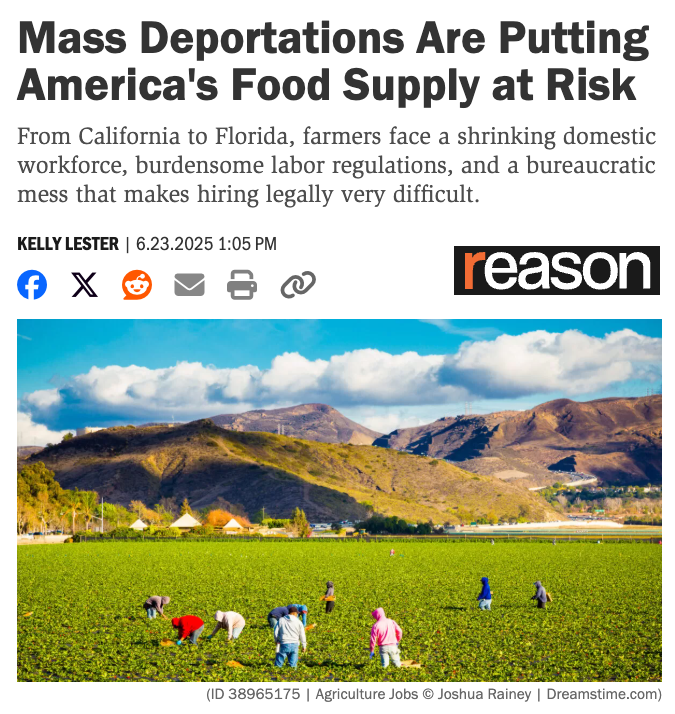
This Reason article (June 23, 2025) is subtitled: From California to Florida, farmers face a shrinking domestic workforce, burdensome labor regulations, and a bureaucratic mess that makes hiring legally very difficult.
Again, the H-2A visa program is a big part of the problem:
But the crisis is bigger than immigration enforcement. Even as undocumented workers are targeted, the legal system that’s supposed to supply agricultural labor—the H-2A visa program—is riddled with costs, bureaucracy, and inefficiency. American farmers are being crushed not only by worker shortages but by a broken guest worker system that cannot meet their needs.
The H-2A visa mess is not just a problem for farms, orchards, and ranches on the west coast. This John Locke Foundation looks at North Carolina: Harvest on Hold: North Carolina’s Agriculture Labor Shortages (April 28, 2025)
U.S. immigration and refugee regulations are a convoluted mess, hurting people and raising costs. The case for cutting and simplifying H-2A guest worker visa should be less controversial than other reforms.