
Blaming Bananas for Poverty in Central and South America
An earlier post, U.S. Foreign Policy and Economic Freedom for Central and South America discussed the history of U.S. military interventions in Central America. I’m researching a separate post on nutritional support programs in Guatemalan mothers and children. But the nutritionist/anthropologist whose book I’m reading begins by blaming corporations, political corruption and capitalism in general for rural poverty in Guatemala. And that means blaming bananas.
U.S. foreign military interventions turned on agricultural needs over a century before the “need” for oil supplies brought military interventions into the Middle East. Most Americans in the 1850s were farmers (64%), and farmers needed fertilizer supplies, which at the time came from birds. Lots of birds. Access to bird guano was a political priority
In his 1850 State of the Union Address, President Millard Fillmore spent a full paragraph on tough talk, committing to do anything necessary to make Peruvian guano available to American farmers. (source: Remember the Guano Wars)
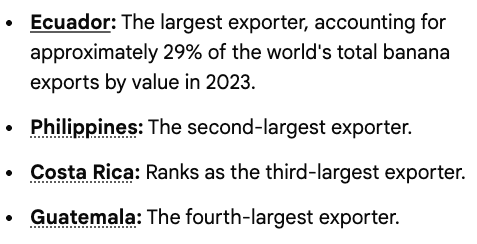
Students researching Guatemalan economic and politics will find bananas past and present take a major role. $1.55 billion of banana exports in 2023, most to the US ($1.18 billion). Guatemala is the world’s third (or fourth) largest exporter of bananas
A six minute TED-Ed video with 3.1 million views presents The dark history of bananas – John Soluri. By the end of the 1800s, Soluri notes, bananas were a hit in the US, available year round. He next claims that US companies had to lobby and bribe Central American officials for access to land to grow their own bananas. But across Central America, land was plentiful and both infrastructure (roads, rail, ports) and labor was scarce.
Some 885,000 people lived in Guatemala in 1900 (others claim 1,885,000. Typo maybe?). Honduras in 1900: 530,000 people. Ecuador in 1900: 1.5 million. Tens of millions of dollars of investments in railroads, ports, roads, and housing.
Foreign capital paid for the infrastructure needed to build out banana plantations and the fast transportation networks to ship them to US markets before they were overripe. Tens of millions of banana laborers were needed as well, and high wages were a magnet for workers (“high” compared to other opportunities through the late 1800s and 1900s).
Populations expanded fast and by 1950, 2000, and 2025:
• Guatemala: 3.3 million, 12.2 million, 18.7 million
• Honduras: 1.55 million, 6.5 million, 11 million
• Ecuador: 3.5 million, 12.6 million, 18.3 million
Banana production wasn’t the only driver for these booming Central and South American economies, but it was a major one. Somehow Guatemala has 18 million more people living and working now than 125 years ago. So bananas and banana companies can be blamed for inequality, malnutrition, and poverty today, and violence past and present. But should bananas and banana companies receive at least some credit for the 18 million more Guatemalans alive today?
We wish they were better fed and more prosperous. How does blaming past and present banana production help?
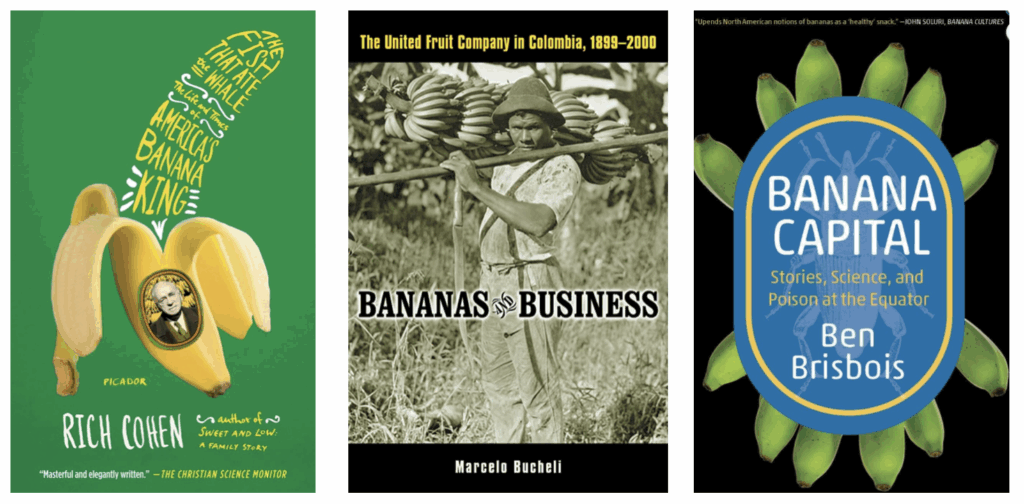
• U.S. Foreign Policy and Economic Freedom for Central and South America (July 17, 2024)
• End Military Commitments for Bird Guano and Oil? (July 17, 2024
• …Topics: E.U. Migration, Development, Humanitarian Aid (updated July 17, 2024) Other articles, books, and studies will reach further back to claim that past U.S. military interventions in the region, to support U.S. corporations are a part of the problem. Others claim that American consumers are to blame when they buy low-cost bananas farmed and imported by U.S. corporations that pay low wages, instead of more expensive bananas from family farms.
• How Many Will Die When Netflix Shoots One Hundred Years of Solitude? (updated Oct. 17, 2025).
• Economic Fallacies Form Shaky Foundations for U.S. Middle East Policy (updated June 27, 2018):
If Peru insisted on getting a lot of money for a valuable product, the only solution was invasion. Seize the guano islands! Spurred by public fury, the U.S. Congress passed the Guano Islands Act in 1856, authorizing Americans to seize any guano deposits they discovered. Over the next half-century, U.S. merchants claimed 94 islands, cays, coral heads and atolls. [“How the Potato Changed the World,” Smithsonian]
The Path to Normal Nutrition (March 17, 2021). Bananas mentioned: Overweight people have a metabolic problem, and better advice would be to eat less of the wrong foods: carbohydrates in general, and especially sugar, high fructose corn syrup, and over-sweet fruits like oranges and bananas.