
After Overturning Chevron, Reform of Congress
The NCFCA debate topic for 2025-26 is: Resolved: The United States Federal Government should significantly reform Congress. NCFCA provides a Policy Resolution Background Paper here.
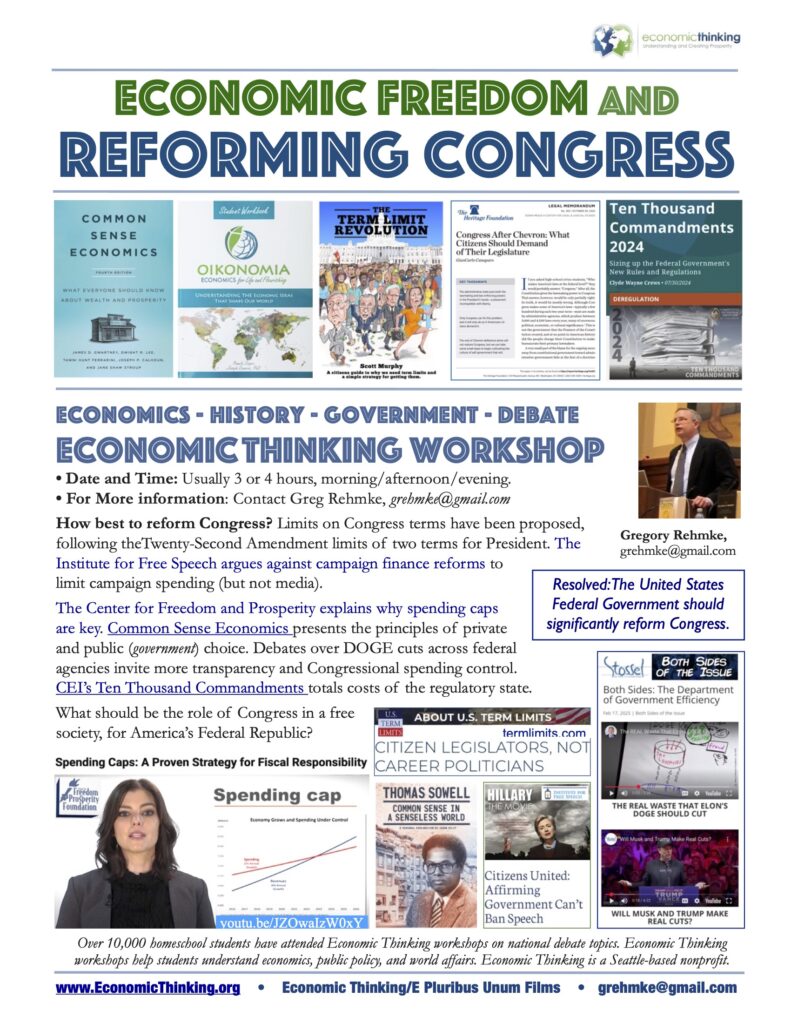
For the NCFCA national tournament, this flyer discussed relevant economics public choice theory, recommending books and reform ideas (pdf with links here).
Among the recommended reforms was: Congress After Chevron: What Citizens Should Demand of Their Legislature (October 30, 2024).
More recently Senator Eric Schmitt authored the Post-Chevron Working Group Report in the Harvard Journal of Law and Public Policy: Per Curiam, Summer 2025). The article outlines short, medium, and long-term legislative proposals. The introduction:
Following the Supreme Court’s overruling of the Chevron doctrine in Loper Bright Enterprises v. Raimondo,1 Congress must act. While the overruling of the Chevron doctrine was widely expected,2 Congress has sat on its hands in the months that have followed. Loper Bright changed the administrative law landscape and the relationship between the Executive and Judicial branches.
In response, twenty GOP Senators banded together to form the Working Group both to diagnose what this change meant for the Legislative Branch and chart a forward-looking path through this “wet cement” moment for our separation of powers.
“Chevron deference was ‘not a harmless transfer of power’ but a “fundamental disruption of our separation of powers.”3
The core Congressional reform for a post-Chevron case is (in my view) the return of legislative powers to Congress. The Chevron doctrine had the courts defer to administrative agencies (the hybrid legislative/executive/judicial federal agencies) on issues science and legislative policy.
Pacific Legal post on X (July 23, 2025):
NEW RESEARCH: The Congressional Review Act was supposed to give Congress power to overturn bad regulations. But in nearly 30 years, it’s been barely used. despite federal regulations exploding by 44% to over 190,000 pages.
2/ Since 1996, federal agencies have submitted 91,730 final rules to Congress. Out of all those regulations, Congress has introduced disapproval resolutions for only 506 (0.6%). That’s shocking underuse of an important oversight tool.
3/ Even worse: Of those 506 disapproval resolutions introduced, only 36 successfully overturned agency rules. That’s just 0.04% of all agency rules submitted. Before 2017, Congress had overturned exactly one rule in over 20 years.
4/ The Constitution gives Congress alone the power to make laws, but over time, Congress has allowed federal agencies to co-opt this power through rulemaking. This created an administrative state that writes rules with the force of law, while the branch that’s supposed to represent the people sits on the sidelines.
When is an emission a Clean Air Act covered pollutant?
A powerful and impactful example of the Chevron Doctrine was the Environmental Protection Agency’s decision to reclassify carbon dioxide (CO2) and a pollutant under the Clean Air Act. Unlike pollutants from burning wood, coal, oil, or natural gas, CO2 emissions weren’t considered pollution when the Clean Air Act was passed (CO2 doesn’t harm people unlessat very high concentrations And CO2 is, of course, food for plants.
Decades after the 1970 Clean Air Act was passed (and amended in 1977 and 1990), concern about increasing carbon dioxide in the atmosphere led to calls for regulating CO2 emissions. Global warming and climate change became major concerns for environmentalists and climate scientists. But that concern doesn’t by itself authorize the EPA to change the definition of pollution to include carbon dioxide. Or at least it doesn’t now, after the Chevron doctrine was overturned.
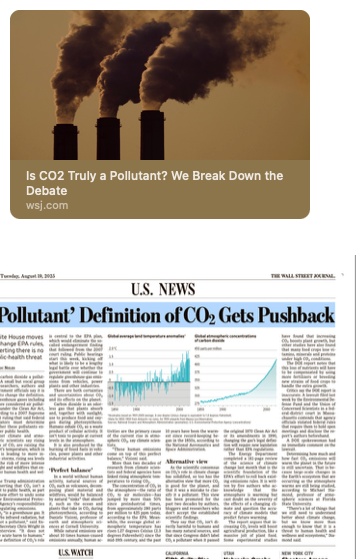
The beginning of this WSJ article (link to online article) is misleading. The Clean Air Act was passed by Congress and later the Environmental Protection Agency (EPA) reinterpreted air pollution to include carbon dioxide, following the science, studies, and models saying CO2 would contribute to global warming/climate change. The article begins:
Is carbon dioxide a pollutant? A small but vocal group of researchers, authors and government officials say it is time to change the definition.
Greenhouse gases including CO2 are considered air pollutants under the Clean Air Act, according to a 2007 Supreme Court ruling that said federal regulators must determine whether these pollutants endanger public health.
But the Clean Air Act, passed in 1970, provided federal regulatory control of air pollution. No one then considered CO2 a source of air pollution.
Most atmospheric scientists see gradual warming CO2 induced global greening (negative take on VOX, positive take in Sect. 2.1) (detailed overview in Climate Working Group report). Some fear a runaway positive feedback loops as more CO2 boosts warming and increases water vapor (another greenhouse gas) in the atmosphere. Lots of theories and many models from climate modelers.
Skeptical take: Global greening drives significant soil moisture loss (nature.com, July 2025). Many, many published studies looking at the downside of CO2 induced global greening.
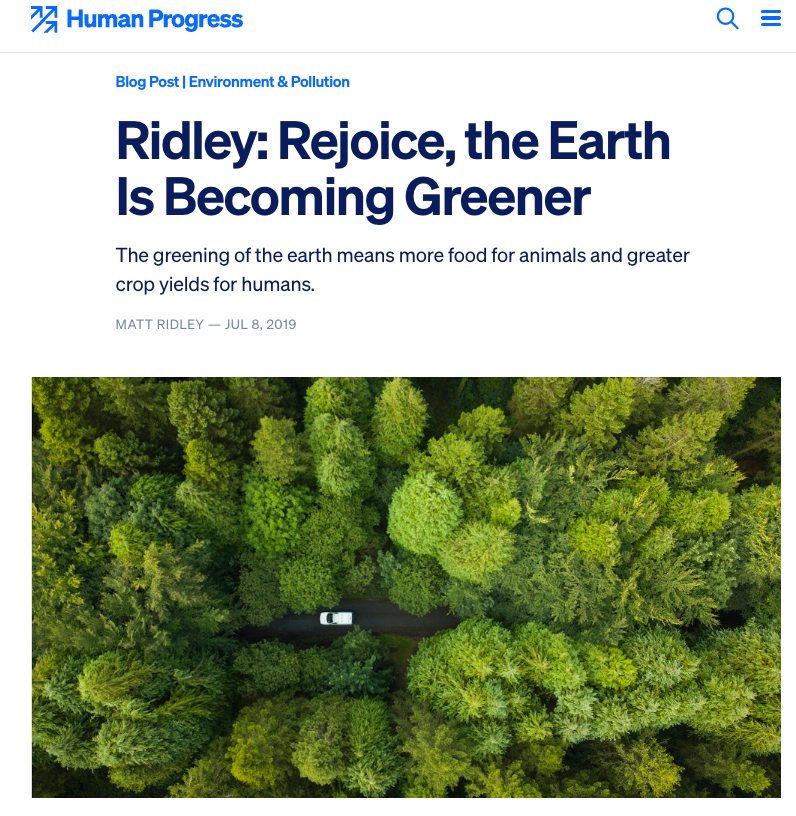
Others look at the upside. In general, green is good. Ridley: Rejoice, the Earth Is Becoming Greener (Human Progress, July 8, 2019)
And Earth Saw Record-High Greening in 2020 (HumanProgress, Phys.org), Feb. 78 2025) Phys.org link.
Okay, after digression and discussion about CO2 and climate change, whose science and climate models should rule the day, and the policy? You could argue that the senators and house members who propose and vote on climate policies don’t know enough to make effective legislation. The Environmental Protection Agencie (EPA) relies on leading atmospheric scientists and climate modelers to support what they claim is “science-based” regulatory policy
For debaters looking to reform Congress, the Constitutional design and principles look to Congress to legislate. Environmental issues are complicated. Who gets to decide the “law of the land”? Congress? The President? The Courts?
To the extend that legislation is involved, Congress is the branch of the federal government to deliberate and decide. The EPA and other Executive Branch agencies can enforce the law, but not legislate new claims, such as the. claim that carbon dioxide is air pollution.