
Time to Sunset Federal Farm Programs
Federal agriculture subsidies, taxes, and regulations confuse and distort farming and ranching across the country. This 2021 article in The New Republic Abolish the Department of Agriculture is subtitled:
The USDA has become an inefficient monster that often promotes products that are bad for consumers and the environment. Let’s replace it with a Department of Food.
The New Republic (AI Overview describes TNR as a prominent American magazine of progressive and liberal political opinion) article cites examples of poor policy decisions then explains:
The USDA, at this point, is so thoroughly captured by big agribusiness that it barely matters which party picks the secretary; whoever serves will ultimately serve mega-corporations and rich farmers. That’s partly because our political system over-represents rural voters and monied interests. But it’s also the product of more banal dysfunctions: poor institutional design, inertia, and mission-drift at an agency built for a different country and a different time.
But why expect federal (or state) politicians and agriculture policy administrators to know what policies are best? Why not leave farmers and ranchers alone, allowing them to discover over time how best to manage their farm and ranch lands?
Stoa debaters with the agriculture policy topic (The U.S. Federal Government should substantially reform its agriculture policy.) have thousands of federal policies to consider reforming and hundreds of substantial ag. policy reforms to propose.
To better understand the present of US agriculture policies, and opportunities for the future, it makes sense to review the past.
Historian Burton Folsom, in The Origin of American Farm Subsidies (The Freeman, April 1, 2006), begins:
In the United States how did we go from having no role for the federal government in farming to having government intertwined in all aspects of farming from planting to harvesting to selling crops?
The Constitution is clear on the subject. Article 1, Section 8, provides no role for the federal government in regulating American farmers. And that is the way it was (with rare exceptions) until about 1930.
American farmers dominated world markets under the free-enterprise system. They were ever creative in figuring out how to gain larger yields of crops through mechanization or through improving crop strains, such as hybrid corn. Americans have been the best-fed people in the world.
Folsom notes Secretary of Agriculture J. Sterling Morton cut federal spending even in the mid-1890s recession, and quotes Morton on the ethical principle involved:
Furthermore, when beet-sugar producers came to Washington eager for some kind of special help, Morton said, “Those who raise corn should not be taxed to encourage those who desire to raise beets. The power to tax was never vested in a Government for the purpose of building up one class at the expense of other classes.”
That philosophy, written in the Constitution by men who were themselves mainly planters and farmers, governed American farming for about 140 years. Even after World War I, when many farmers had to readjust from the high prices commanded during the war, Americans were still determined not to tax one economic group to support another.
https://fee.org/articles/kansas-farmers-need-an-economy-that-can-withstand-a-bad-crop-year
Fast forward to 2016, Daniel Mitchell’s Freeman article, The Absurd World of Agriculture Subsidies (December 16, 2016) quotes Jim Bovard from his WSJ oped Living Off the Fat of Washington:
President-elect Donald Trump’s vow to “drain the swamp” in Washington could begin with the Agriculture Department … Farmers will receive twice as much of their income from handouts (25%) this year as they did in 2013, according to the USDA … big farmers snare the vast majority of federal handouts. According to a report released this year by the Environmental Working Group … “the top 1 percent of farm subsidy recipients received 26 percent of subsidy payments between 1995 and 2014.” The group’s analysis of government farm-subsidy data also found that the “top 20 percent of subsidy recipients received 91 percent of all subsidy payments.” Fifty members of the Forbes 400 list of wealthiest Americans have received farm subsidies, according to the group, including David Rockefeller Sr. and Charles Schwab.
Dan Mitchell explains: Indeed, agriculture subsidies are basically a huge transfer of wealth from the poor to the rich:
… in 2015, the median farm household had a net worth of $827,307. That includes a great many residential, gentlemen and hobby farmers. The largest class of farmers—those who produce most farm products and harvest the largest share of the subsidies—have a median net worth of $2,586,000. By contrast, the median net worth for American households in 2013 was $81,200, according to the Federal Reserve.
And debaters will find a connection to last year’s Central/South America topic here:
In his column, Jim [Bovard] also explains some of the bizarre consequences of various specific handout programs, including the fact that American taxpayers have forked over $750 million to Brazil in order to continue huge (and impermissible, according to our trade commitments) subsidies to American cotton producers.
And fast-forwarding again to 2026, Vance Ginn notes the importance of energy and regulatory ecosystems surrounding agriculture at the state level. Poor weather can bring bad years for farmers. Resilience and institutional stability is key for sustainable agriculture.
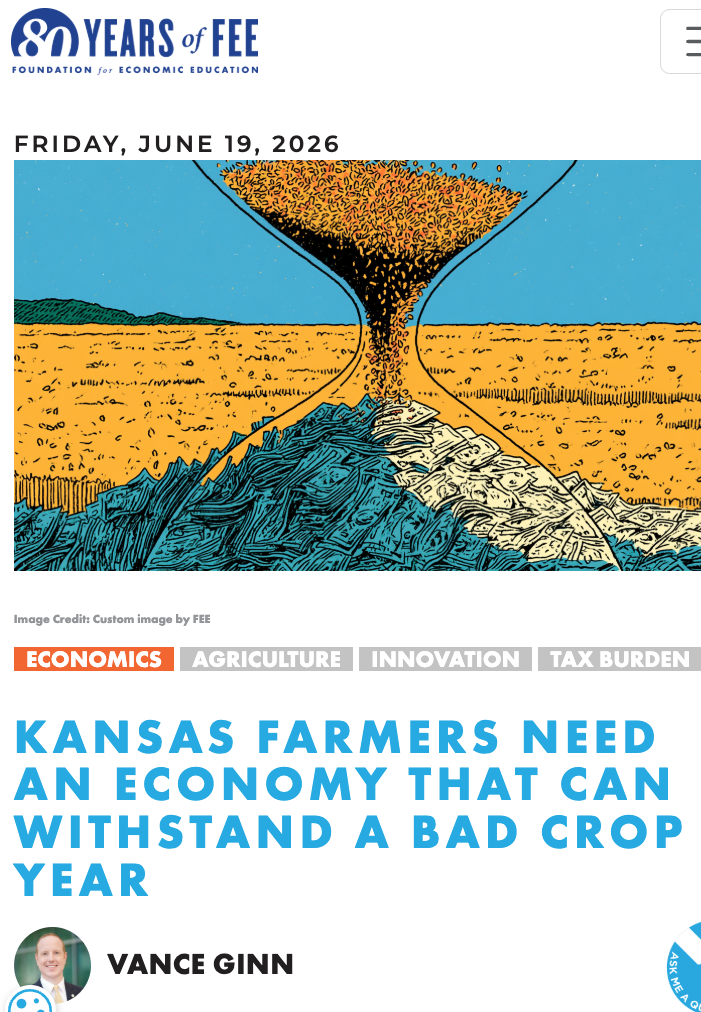
Kansas should protect agriculture by making Kansas more competitive for everything around agriculture: energy, logistics, processing, technology, manufacturing, housing, health care, and entrepreneurship.
A bad crop year is painful. But it can also clarify the path forward. Kansas does not need more government management. It needs a freer, more flexible economy where farmers and businesses can adapt faster than policymakers can write rules.
That is how Kansas becomes more resilient.
Foundation for Economic Education President Emeritus Lawrence Reed called for “reform” in his 2020 article, End the Farm Dose Once and For All:
A new program to require the U.S. Department of Agriculture to pay the cost of inspecting meat from emus and ostriches. A plan to spend $200 million to buy surplus cranberries, black-eyed peas, and other crops. A $100 million proposal for payments to producers of cottonseed. At this writing (June), these were among a bundle of agricultural subsidy schemes either passed by or under serious consideration in both houses of the U.S. Congress.
If you can grow it, and effectively lobby, well then maybe Congress will subsidize it. Maybe every Stoa debate club could choose a crop to raise this summer, then, as preparation for debate, can lobby state and federal legislatures for subsidies of one kind or another.
Many years ago FEE published The Farm Problem:
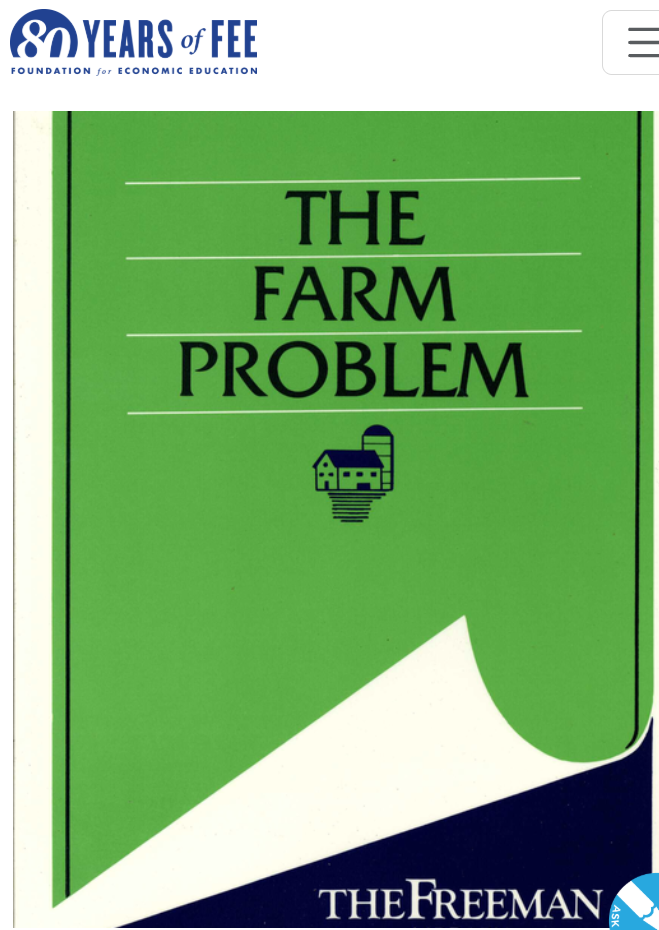
…a compilation of essays to point out the problems of farm policy and to provide alternative solutions. Among the authors included in this collection are John Chamberlain, Edmund A. Opitz, Grover Cleveland, W.M. Curtiss, Clarence Carson, and E.C. Pasour Jr. These essays explain how farm subsidies lead to inefficient outcomes for farmers and waste resources and capital. Particular attention is paid to discussing the destructive policies that continue to plague American agriculture.
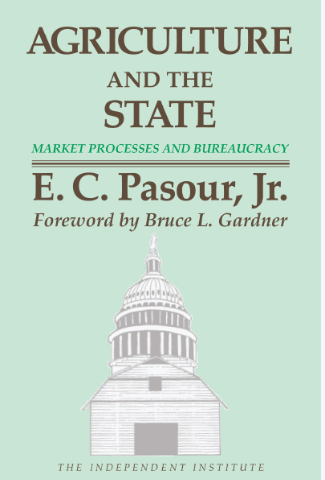
A classic Freeman article by E.C. Pasour, Protetionism and Agricultural Price Supports reports the problems from 1986. I worked at FEE then and helped publish E.C. Pasour’s book on agriculture, Agriculture and the State: Market Processes and Bureaucracy.
The book was later updated and published by the Independent Institute: Agriculture and the State.
There is much, much more to say about reforming today’s federal agricultural programs. I have a number of past Economic Thinking posts here, most tied to past debate topics.:]