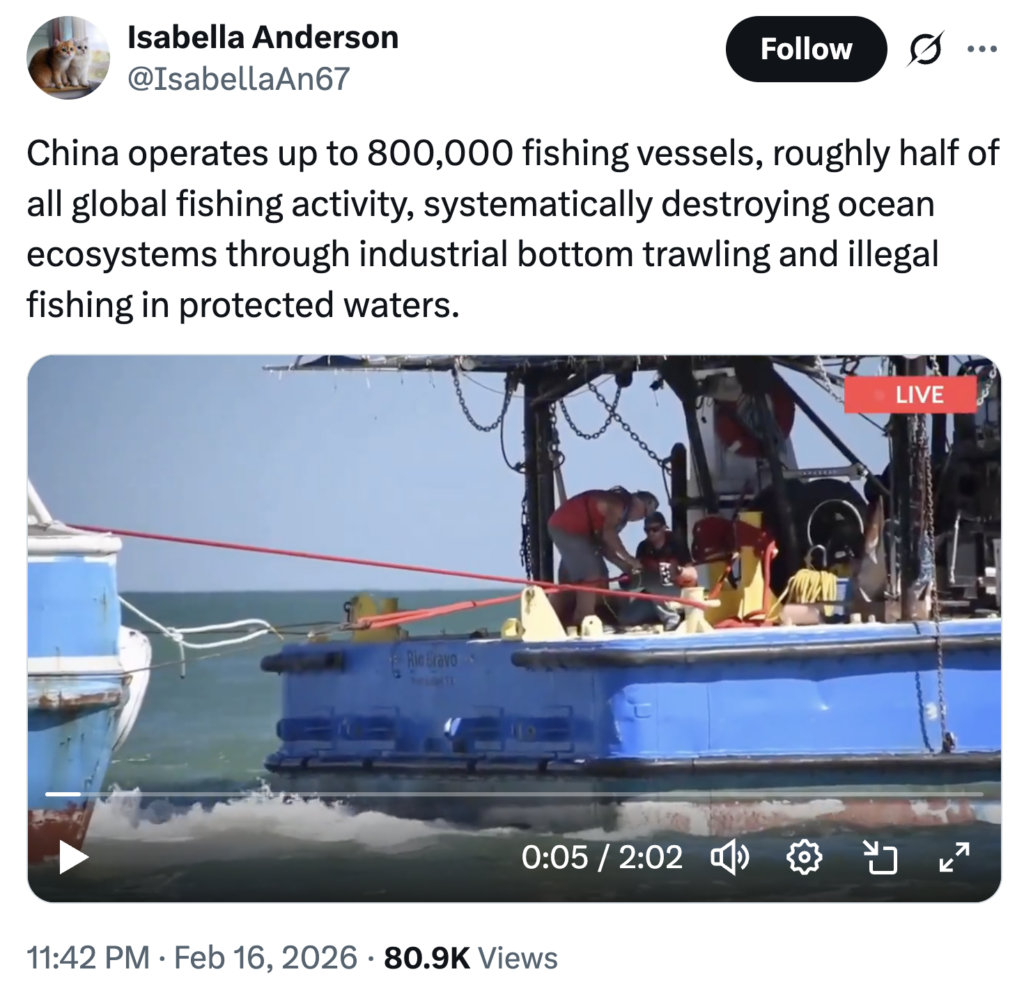
• China operates up to 800,000 fishing vessels, roughly half of all global fishing activity, systematically destroying ocean ecosystems through industrial bottom trawling and illegal fishing in protected waters. Link to x post with video
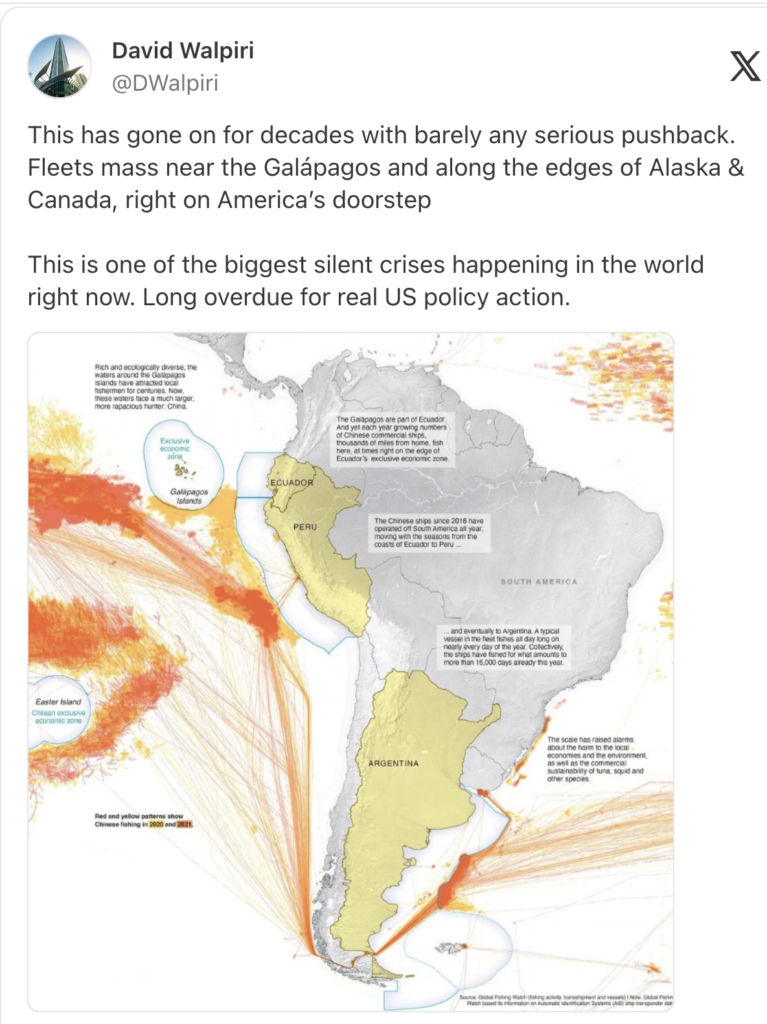
• China’s distant water fleet is decimating sea life around the world. Look at how the fleets concentrate around Africa and South America. They target smaller countries without the resources to confront the state sponsored ships. (Link to X post)
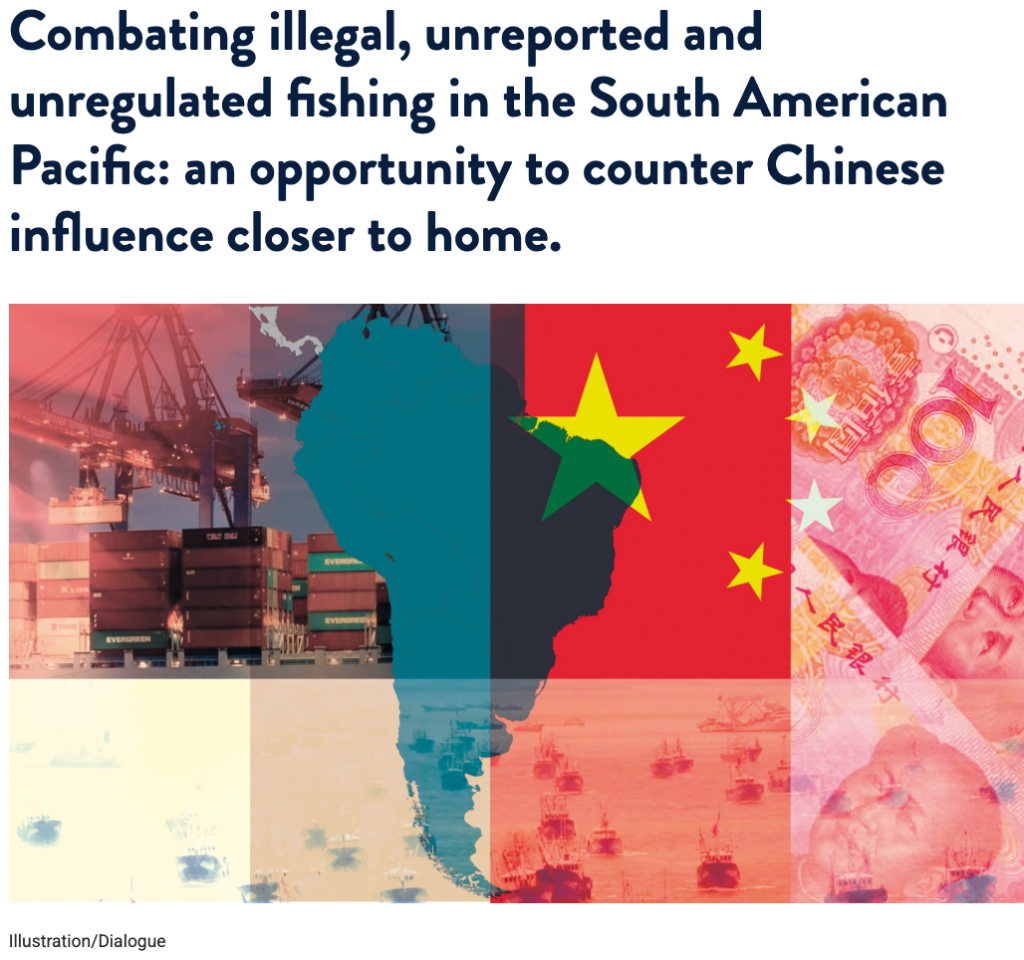
By establishing itself at the forefront in combating illegal, unregulated, and unreported (IUU) fishing activities off the Pacific coast of South America, the United States could strengthen its role as a leader in the Western Hemisphere and counter growing Chinese influence in South America. (Dialogo Americas, February 11, 2026)
Recent news stories highlight the damage Chinese distant fishing fleets are doing to South American fisheries:
• Google AI Overview: “A massive Chinese distant-water fishing fleet, numbering in the hundreds, is severely damaging South American fisheries by overfishing, illegally entering exclusive economic zones (EEZs), and targeting vulnerable species near the Galapagos Islands and off the coasts of Chile and Argentina. The fleet, which often turns off tracking systems to operate “dark,” has caused significant ecological and economic harm.”
An alternative is for Chinese companies to pay for opportunity to buy their way to access to South American fisheries:
Chinese companies now control at least 62 industrial fishing vessels that fly the Argentine flag, including the majority of Argentina’s squid fleet. Many of these companies have been tied to a variety of crimes, including dumping fish at sea, turning off their transponders, and engaging in tax evasion and fraud. Trade records show that much of what is caught by these vessels is sent back to China, but some of the seafood is also exported to countries including the United States, Canada, Italy, and Spain. (Source: Taking Over from the Inside: China’s Growing Reach Into Local Waters (The Outlaw Ocean Project)
…high-stakes encounters between Chinese fishing vessels and South American authorities have been common over the past decade. In 2016, an Argentine coast guard vessel sank the Lu Yan Yuan Yu 010, and in 2019, it fired on the Hua Xiang 801; both were Chinese DWF vessels caught fishing inside Argentina’s exclusive economic zone (EEZ).3 Similarly, the Ecuadorean navy confiscated the Fu Yuan Yu Leng 999 in 2017 for fishing inside the Galápagos Maritime Reserve.4
With China’s expanding presence in South America, these at-sea confrontations have tarnished the positive image China has tried to convey. They have also created an opportunity that the United States could exploit. By establishing itself at the forefront in combating illegal, unregulated, and unreported (IUU) fishing activities off the Pacific coast of South America, the United States could strengthen its role as a leader in the Western Hemisphere and counter growing Chinese influence in South America. To achieve this end, the United States must adopt a uniform approach to curbing IUU fishing, encourage the South Pacific Regional Fisheries Management Organisation (SPRFMO) — an international treaty-based organization — to implement unambiguous regulations that nations could easily enforce, and strengthen counter–IUU fishing operations with South American partner countries as well as with China.
Without property rights, open ocean fisheries are at risk of explotation. As fisheries technologies advance, high numbers of open ocean fish can be located, caught, and processed. As China’s Deep Water Fleet has expanded, it has not only swept up more fish outside South American country Exclusive Economic Zones (EEZs), but ships have turned off transponders to fishing illegally inside EEZs.
China’s South American DWF fleet — which began as a relatively small enterprise three decades ago in response to the decline of squid fishing in China — has grown exponentially and now numbers more than 500 vessels.16 In an industrial-like operation, the deep-sea fishing vessels rely on refrigerated mother ships to store their catches, transport fish to ports, and supply the vessels with food and fuel. The fleet operates for months at a time and can resemble an island city-state, covering stretches of ocean nearly 200 miles (300 kilometers) long, equivalent to the length of the entire coastline of South Carolina.
The imposing presence of Chinese DWF creates a growing problem for South America’s Pacific coastal nations. Although Chinese DWF vessels claim to operate outside each country’s EEZ, their practices are questionable: turning off their automatic identification systems to traverse EEZs undetected, deploying expansive underwater fishing nets in an EEZ while keeping the vessel outside EEZ boundaries, or fishing for protected or regulated species.17 For example, in 2017, the Ecuadorian navy discovered 7,639 undeclared sharks aboard the Fu Yuan Yu Leng 999, a Chinese vessel registered for squid fishing.18 More concerning is the impact that industrial-scale fishing has had on the ecosystem, disrupting fish migration patterns along the South American coast and depleting species needed to sustain local artisanal fisheries. 19 For countries like Ecuador, the world’s seventh-largest tuna producer, or Chile, where fish is the largest export product after copper, the impact is enormous. 20
Saving fisheries off the coasts of Central and South America requires some kind of property rights to align incentives with the long-term health of fisheries. This PERC article, Save Fish, Establish Property Rights May 8, 2017) notes:
The Future of Fish
Rights-based innovations in fisheries—including using them to manage bycatch—have improved marine fisheries economically and ecologically. Using command-and-control regulations to manage bycatch and meet conservation targets, by contrast, “would require information that is time- and place-specific and knowledge that is dispersed among resource users and unavailable to any central manager,” Miller and Deacon write. Property rights in the form of catch shares “gave individual fishers incentives to use their dispersed knowledge to find least-cost solutions.”
A new generation of innovation in commercial fisheries shows that where property rights have been made clear, secure, and transferable, the negative environmental effects of overfishing have been reduced, and the safety and economic performance of the fishing industry have generally improved. With many of world’s fishing grounds under ecological and economic threat, rights-based management approaches could provide the best boost to the future health of marine fisheries.