Adventures in Arctic (and Space) Exploration and Development
The National Speech and Debate Association policy resolution for 2025-26 is: The United States federal government should significantly increase its exploration and/or development of the Arctic (NSDA topics page)
Debate students and coaches are researching Arctic exploration, from oil, gas, and minerals exploration and development, to fisheries, tourism, scientific research, and environmental protection. Much to explore and develop in the Arctic through the summer months, and much harder through the long Arctic winters. Exploring and developing the Arctic is costly and dangerous, as is exploring outer space, which is this year’s NCFCA league Lincoln Douglas topic.
Exploration across Arctic land, sea, and air, and onto outer space is the realm of entrepreneurs and enterprises. Economist Alexander Salter discusses The forms of space entrepreneurship (The Space Review, Sept. 8, 2025). Exploration, again, is costly, so enterprises with new technologies to lower costs is key. What new technologies can reduce the cost of Arctic exploration and development? Think drones…

An AI Overview, image right (10/12/2025 search: “new drone technology for Arctic exploration”), and here is separate discussion of Sweden’s military drone project for the Arctic. Here is a recent Arctic military overview: Inside the West’s Race to Defend the Arctic
Russia holds a large advantage in the high north. NATO’s effort to catch up is beset by challenges (WSJ, October 11, 2025)

History offers centuries of adventures exploring the edges of the world to amaze and astonish. Venturing out to unexplored seas and lands, scouting and surveying, discovering and trying to survive. Arctic climate researcher Nina Maherndl (Lepzig University) provides history and horror stories of Arctic exploration: The Insane History of Arctic Exploration | Stories from 3 Expeditions to the North Pole.
As with space exploration (also the 2011-12 NSDA policy topic) Arctic exploration has long been a project of nations-states and national enterprises (state-chartered trading companies).

In my 45 minute presentations for the University Interscholastic League, I encourage students to research the history of Arctic exploration and its economic drivers past and present. Arctic explorers searched for new fisheries and trade routes (especially the fabled northwest passage to Asia). Prize money incentivized earlyArctic exploration and continues to today.

Prizes advanced ocean exploration, with the 1714 Longitude Prize (Dava Sobel’s book Longitude) The UK’s Polar Medal created in 1857 (originally the Arctic Medal) was given to those “engaged in the several Expeditions to the Arctic Regions…” The Arctic Circle Prize says it is: “awarded for extraordinary contributions to the continuous work of securing a sustainable and prosperous future in the Arctic.” But most recent Arctic Circle Prizes have gone to politicians (Senator Lisa Murkowski, John Kerry (former Senator and Secretary of State, Ban Ki-Moon (UN). The 2022 prize though went to the Alfred Wegener Institute for it’s 2019 MOSAiC Expedition to the Arctic.
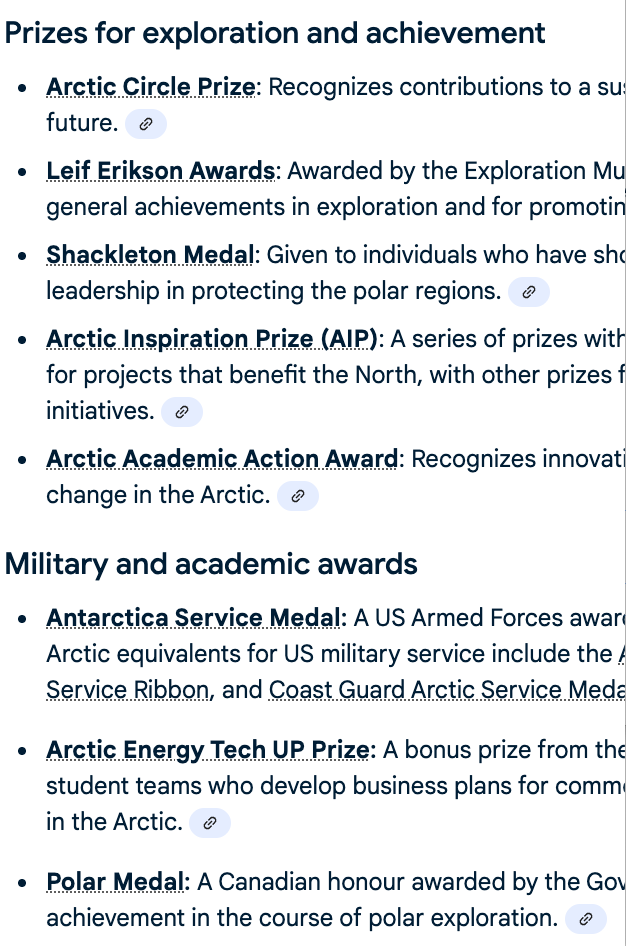
Various Arctic exploration prizes are listed online (see image at right).
Just as debate competition motivates students to search for sound policy reforms and projects, Arctic exploration prizes continue to motivate Arctic explorers, as well as help provide funding.
The history of air and space development is similar, with prizes playing a key role in spurring and funding new innovations and technologies, from Charles Lindberg’s Spirit of St. Louis flying from New York to Paris, to StarShip One winning the Ansari X Prize. Excerpt below from Economics of Space Exploration Study Guide, prepared for the 2011 space exploration policy topic:

Contests have a long history of enabling exploration across land, sea, air, and now outer space. Dava Sobel’s Longitude recounts the British government’s £20,000 prize offered to the inventor of a way to measure longitude, in order to increase ocean exploration.
The Ansari X PRIZE was modeled after the Orteig Prize, won by Charles Lindbergh in 1927 for being the first to fly non-stop from New York to Paris, and mirrored the hundreds of aviation incentive prizes offered early in the 20th century that helped create today’s $300 billion commercial aviation industry. Dr. Peter Diamandis designed the prize after reading The Spirit of St. Louis about the Orteig Prize.
… The Ansari family [became] the title sponsors of the first X PRIZE, jumpstarting 26 teams from 7 different nations to pursue their passions by competing for the prize. Those 26 teams combined spent more than
$100 million to win the prize.
From Prizes to Arctic Policy Debates
A major Arctic development debate is over the Alaska National Wilderness Refuge (ANWR). Decades of legislation, political maneuvering, and litigation concern oil and gas exploration and drilling on parts of ANWR.
Earlier this year, according to the Alaska Beacon (March 25, 2025):
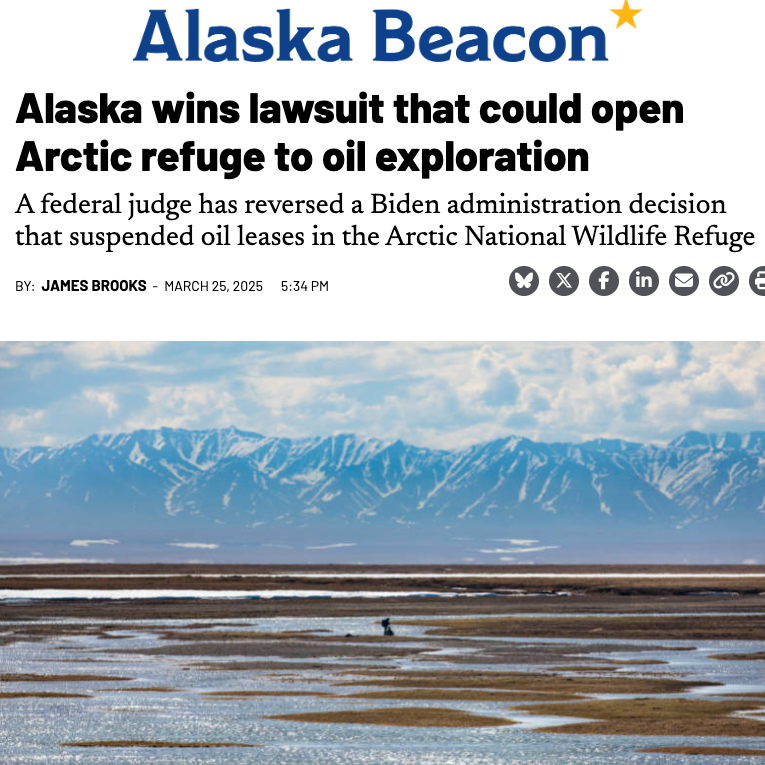
A federal judge in Anchorage has ruled in favor of Alaska’s state-owned investment bank in a lawsuit that could clear the way for oil drilling in the Arctic National Wildlife Refuge.
In an order published Tuesday, Judge Sharon Gleason wrote that the U.S. Department of the Interior acted illegally when it canceled oil and gas leases held by the Alaska Industrial Development and Export Authority on land within the refuge.
Exploring for oil and gas in the Arctic is risky and costly, so oil companies want legislation allowing them to drill for oil and gas if they find deposits. Estimates for Alaska’s Arctic, for “technically recoverable resources” are “40 billion barrels of oil and 124 trillion cubic feet of natural gas on federal lands alone.”More from US Geological Survey in Alaska Beacon, (July, 5, 2025).
Pushing back at efforts to restart oil and gas exploration in ANWR is this editorial in The Hill (April 30, 2025), Stop gambling taxpayer dollars on Arctic drilling delusions. The authors note that projected federal revenue from new oil and gas leases has long been way overstated. The authors claim that ANWR development would be a huge risk to Alaska’s wilderness economy. They write: “…recent data highlights that outdoor recreation accounts for nearly 5 percent of Alaska’s economy — it added more than $3 billion to the state economy in 2023 and supports 6 percent of Alaska’s jobs.” And they claim:
By pushing speculative oil leases, lawmakers are jeopardizing the reliable revenue that outdoor recreation generates for local communities and the country. Sacrificing one sector’s proven economic gains for uncertain drilling prospects is fiscally irresponsible and shortsighted.
However, of the $3 billion from fishing, hunting, and wilderness, very little flows from ANWR. It’s a hard place to get to and get back from. The author’s say the Arctic Refuge is “a vital ecosystem…that sustains Alaskan livelihoods through hunting, fishing and outdoor recreation.” But how many livelihoods? If it’s a numbers game, how many more might be “sustained” by supporting new oil and gas exploration, development, and transportation?
Here are Alaska visitors numbers I found online:
• Alaska 2016: 30-36 million sport fishermen.
• Alaska visitors: 3 million per year
• Alaska from 1996-2016: 11.5-14 million hunting
• ANWR visitors: 2,000 per year
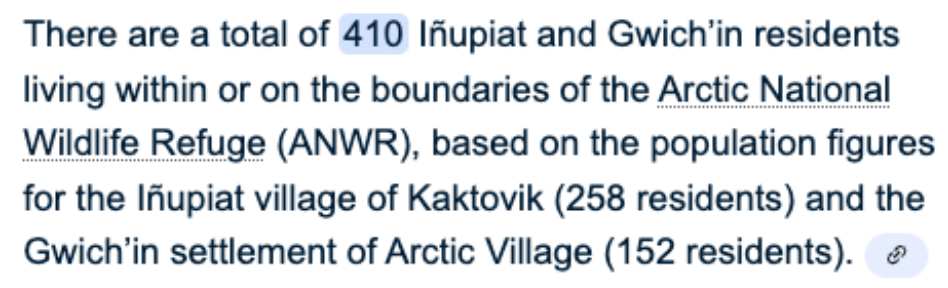
Also online, notes extimating 410 ANWR indigenous people:
For further discussion oil and gas drilling in ANWR, contrasting formal and informal governance, see Governing the Arctic National Wildlife Refuge
The Last Piece of Untouched Land in the United States and an Everlasting Debate on Oil (Storymaps, December 12, 2021).
Next is a discussion of Garrett Hardin’s Tragedy of the Commons:
…he explains a hypothetical scenario in which many people have access to the commons (a common resource) and in using this resource, individuals will consume for their best interest until the resource is depleted. In the Tragedy of the Commons the “greatest good for the greatest number (Hardin, 1968)” cannot be achieved, Hardin also discusses how population is a fault in the tragedy, and that “freedom to breed is intolerable (Hardin, 1968).” Despite this, Hardin believes that a solution to the tragedy would be to privatize property.
Following Hardin the author reviews Elinor Ostrom’s research on how societies actually deal with scarce resources with social norms and collection action to avoid shared resources being depleted:
…Hardin leaves crucial information out of his theory, and that there are other solutions to preventing a tragedy of the commons. Elinor Ostrom has discussed the concept of collective action, in which individuals who share common interests would achieve that objective if it were to make everyone better off (Ostrom, 1990). Similarly, authors of Tragedy revisited [Science, 14 Dec 2018] believe that both collective action and social norms will allow for the sustainable management of the commons (Boyd et al., 2018).
Further discussion of Elinor Ostrom here: Elinor Ostrom and the Solution to the Tragedy of the Commons, and Elinor Ostrom: Pioneering a New Understanding of Common Resources. And here is a video overview:
Dwight Lee suggests we let Environmentalists Decide
How might environmental organization decide about development, if they owned ANWR? Drilling for oil is costly but provides benefits. Could property owners produce oil and gas yet still protect the surrounding environment? Of course then can, and do across thousands of locations on government, private, and nonprofit lands. Many are naturally skeptical of for-profit enterprises tempted to save money by cutting environmental protection. Common Law legal institutions long provided protection from development “externalities” (costs external to the property developed, i.e. water and air pollution that harms neighboring areas).
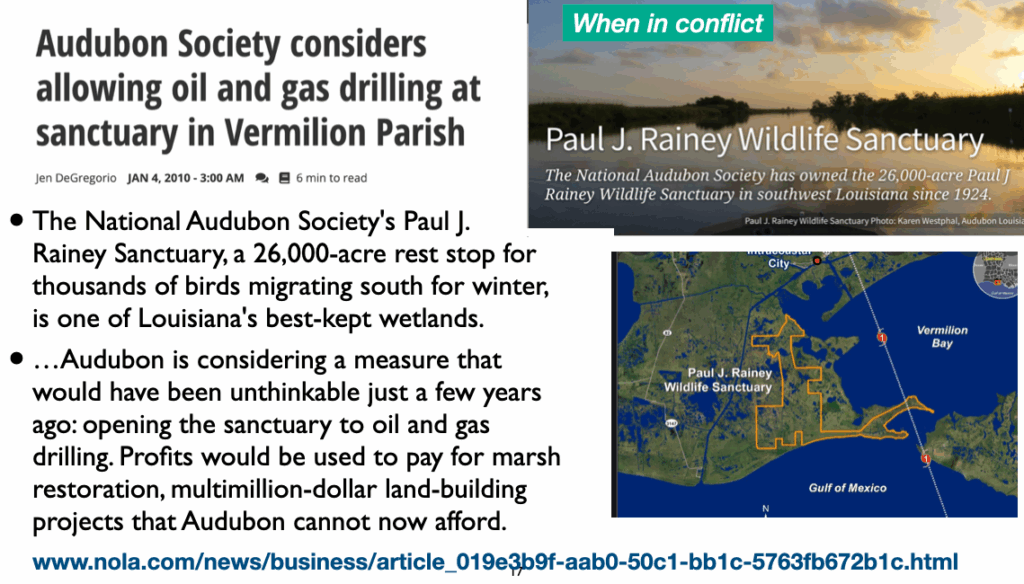
What if instead of the Federal or Alaska government making the decision on ANWR oil and gas drilling, a long-established and respected environmental organization were to make the decision on drilling for oil and gas? Dwight Lee offers an example from history and the Au
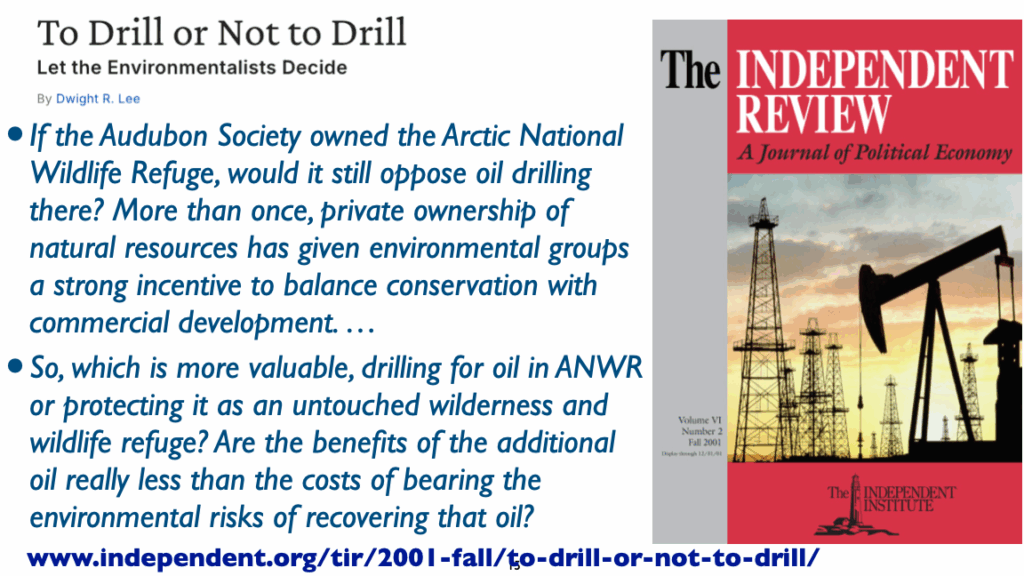
To Drill or Not to Drill: Let the Environmentalists Decide (Dwight Lee, The Independent Review, Fall, 2001)
If the Audubon Society owned the Arctic National Wildlife Refuge, would it still oppose oil drilling there? More than once, private ownership of natural resources has given environmental groups a strong incentive to balance conservation with commercial development. …
Yet since the early 1950s, 37 wells have pumped natural gas (and a small amount of oil) at various times from Audubon’s Paul J. Rainey Sanctuary, a 26,000-acre preserve … in Louisiana. These wells have produced more than $25 million in revenues for the Society. (Quoted from PERC article PC Oil Drilling in a Wildlife Refuge)