
Too Much Money Spent on Political Campaigns Or Potato Chips? (Or both?)
 At the Ethos Debate camp at Patrick Henry College last week, I spoke on the NCFCA topics for the first time.
Chip makers know what we want, based on our social status — so they target their advertising to appeal to different class values, according to a new Stanford analysis of the marketing of a dozen different brands.
Cheaper chips promote working class values of economy, tradition and homeyness — while high-priced chips promise an exotic and “natural” experience, discovered linguists Joshua Freedman and Dan Jurafsky.
“The red-state and blue-state models of our nation are written on the back of every bag of potato chips,” concludes professor Jurafsky.
The project started with visits to grocery stores, where grad student Freedman photographed the language on potato chip bags — and attracted the stares of puzzled employees. (Source.)
 You can read more in Smith’s book Unfree Speech: The Folly of Campaign Finance Reform (Princeton Univ. Press, 2003) on Amazon. (And a number of used copies are available used). Smith is quoted favoring abolishing “leadership PACs” in this article, though in more campaign finance areas, he favors less FEC regulations. Smith especially favors making it harder to prosecute people accused of violating ever more complex federal election laws, as discussed in this July, 2013 Huffington Post article.
Economic Regulation Attracts Special Interest Money
As important as all this potato chip research may be, the bigger issue I think, is overall spending by politicians after they are elected, rather than before.
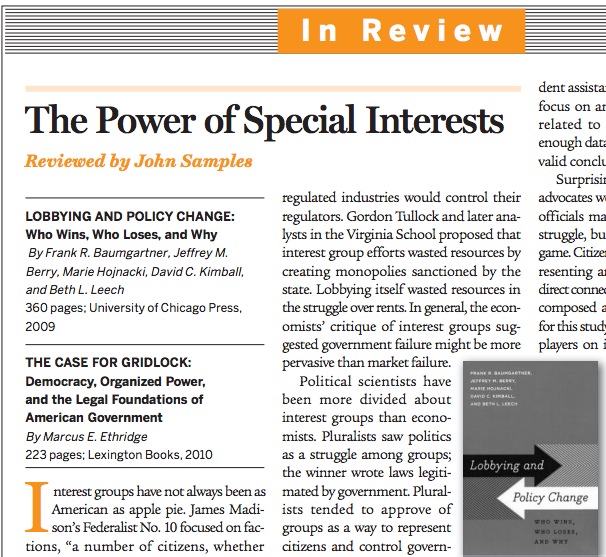 A lot of corporate money is spent on political campaigns, associations, and political action committees because a lot is at stake. Most are skeptical of special interest groups that donate to election campaigns to protect their own industry. But research shows these special interest donations surprisingly ineffective. This Cato review in Regulation is helpful, “The Power of Special Interests.”
Consider wireless companies and corporations that own television stations. TV stations control wide swaths of electromagnetic spectrum beyond what they use for their main stations, and they continue to broadcast old TV shows and Abbot and Costello movies on the excess bandwidth. This same bandwidth would be much more valuable as wireless spectrum for smartphone calls and data. TV stations don’t own the spectrum, they just sit on it from the old days of analog broadcast.
 So television stations and broadcast associations lobby Congress for regulations that allow them to profit from transferring bandwidth they don’t much use and never owned to myriad wireless firms starved for spectrum. All these players, along with their lawyers and lobbyists, donate to political candidates, party fundraisers, nonprofits researching and writing on the topic, as well as too consultants eager to advance one side or the other. Small changes in legislation wording can means tens or hundreds of millions of dollars to corporations active in government controlled land, sea, or air space.
This 2011 New York Times story discusses the fight over federal spectrum assets and regulations.